中文简体
中文简体 Español
Home / Resources / Industry News / Folding RV Sink Buying Guide: Space-Saving Designs, Sizes, and Top Tips
Industry News
Oct 16,2026
Folding RV Sink Buying Guide: Space-Saving Designs, Sizes, and Top Tips
Content
A folding RV sink solves one very specific problem: counter space is the scarcest material in a camper kitchen. On a galley where the hob and the sink share the same 600 mm of worktop, a fixed bowl permanently costs you the only prep area you have. A sink that folds, or at least closes flush under a lid, gives that surface back the moment the washing up is finished.
So here is the conclusion before the reasoning. Choose a folding or covered sink if the counter depth is limited, if the bowl sits directly beside a stove, or if the galley is used a few times a day rather than for long cooking sessions. Stay with a fixed single bowl if you work in the same spot for hours and never need extra worktop. The folding mechanism earns its keep when space, not capacity, is the constraint.
What Actually Folds on a Folding RV Sink
Most buyers picture the bowl itself collapsing. In the products sold as folding RV sinks, the bowl is normally a rigid pressed stainless steel body, and one of three separate parts is what moves:
- A hinged cover that folds down over the opening and doubles as a prep or cutting surface.
- A tempered glass lid that closes flush, usually held by a latch, a hinge or a gas strut.
- A folding or retractable faucet that tips down so the lid can shut without striking the spout.
Fold-down basins do exist, but they are usually bathroom fittings hinged against a wall. In a kitchen layout the movement happens above the bowl, not to the bowl, and that distinction matters as soon as you start measuring clearance.
Sizing: Four Numbers to Check Before You Cut
The most common reason a folding sink fails to fit is that the buyer measures the bowl and forgets the cover swing, the faucet arc and the drain trap underneath. Four figures decide the outcome: counter depth, cabinet interior depth, countertop cutout and the height of the faucet when it is folded flat.
Sinks are usually sold by overall size, while counters are cut to the cutout. A 465 x 350 mm bowl may need a cutout closer to 440 x 325 mm once a 15 mm rim is allowed for, and that rim is what the lid hinges on. Treat catalogue sizes as a starting point and confirm the drawing before any panel is cut.
| Configuration | Typical bowl footprint | Cover type | Where it works |
|---|---|---|---|
| Round cooker sink with glass lid | 370 to 400 mm diameter | Flush tempered glass | Short-wheelbase vans and boat galleys |
| Rectangular single bowl with glass lid | 465 x 350 mm | Glass lid with latch | Campervans and motorhomes |
| One-burner hob and sink combination | 700 to 900 mm overall | Single panel over both | Compact galleys used for light cooking |
| Two-burner hob and sink combination | 900 to 1100 mm overall | Two lids or a split lid | Larger motorhomes with a full galley |
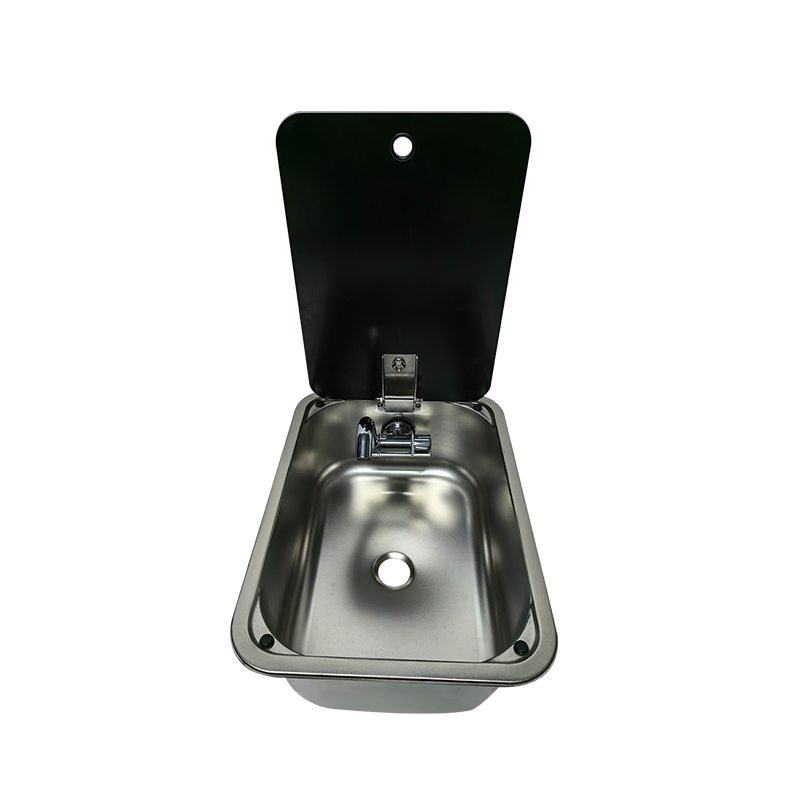
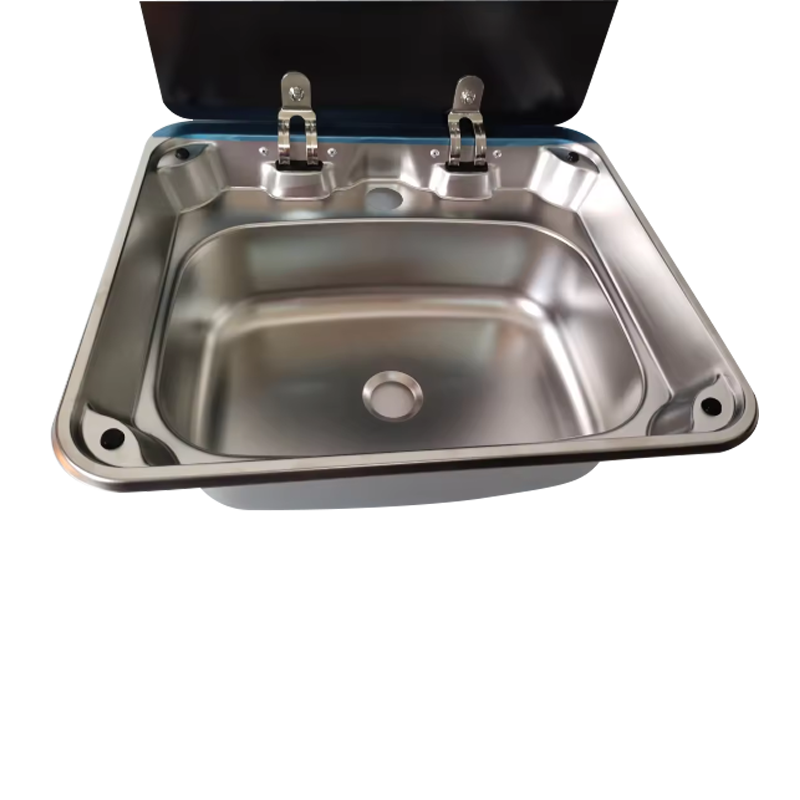 304 Stainless Steel Rectangular RV Sink with Glass CoverRectangular 304 stainless steel single-bowl RV sink with tempered glass cover; check cutout and lid clearance before ordering.View Product →
One more dimension catches people out: the swing of the lid. A cover that opens upward needs vertical clearance for a raised roof, a locker door or a window, while a cover that lies flat on the counter consumes the surface you were trying to recover. Decide which behaviour suits your layout before choosing the model.
Glass Lid or Metal Fold-Down Cover
Both options hide the bowl, but they behave differently in daily use, and the choice usually comes down to weight, noise and how much abuse the galley sees.
- Tempered glass lids close flush, wipe clean easily and read as a countertop rather than a sink. They are heavier, and impact on a hard edge can shatter them, so check how the hinges and bump stops are made.
- Fold-down stainless covers are lighter, cheaper to replace and almost impossible to break, but the folded panel has to go somewhere, often into a recess or flat across the adjacent counter.
- Slide and roll covers need no swing clearance at all, which helps in tight corners, at the cost of more moving parts to clean and maintain.
- Whichever cover you pick, the faucet is often the deciding part. A spout that stands 200 mm tall cannot live under a lid that closes at 40 mm, which is why folding taps are so common in this category.
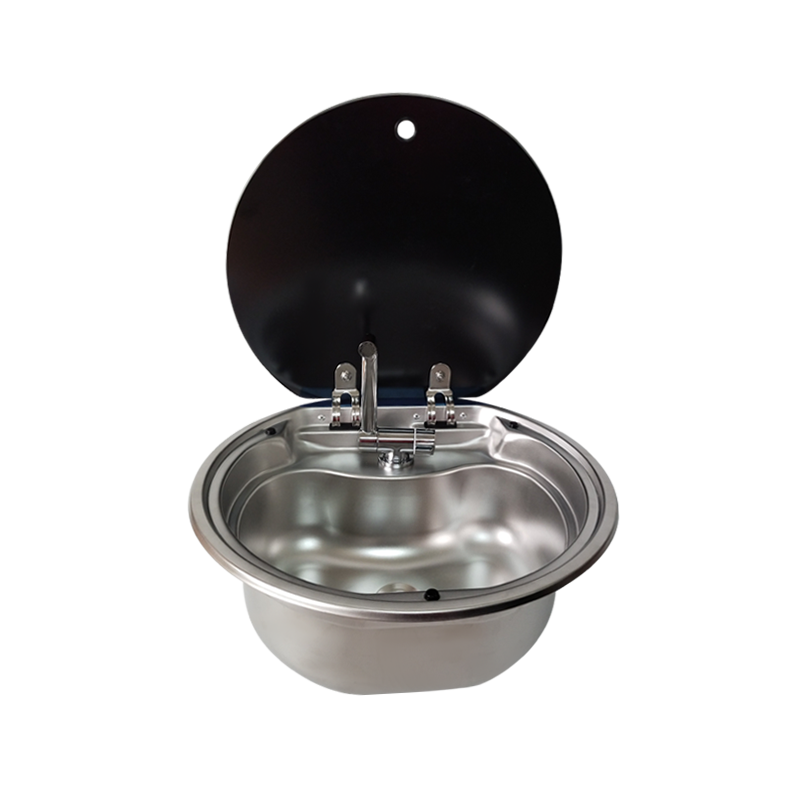
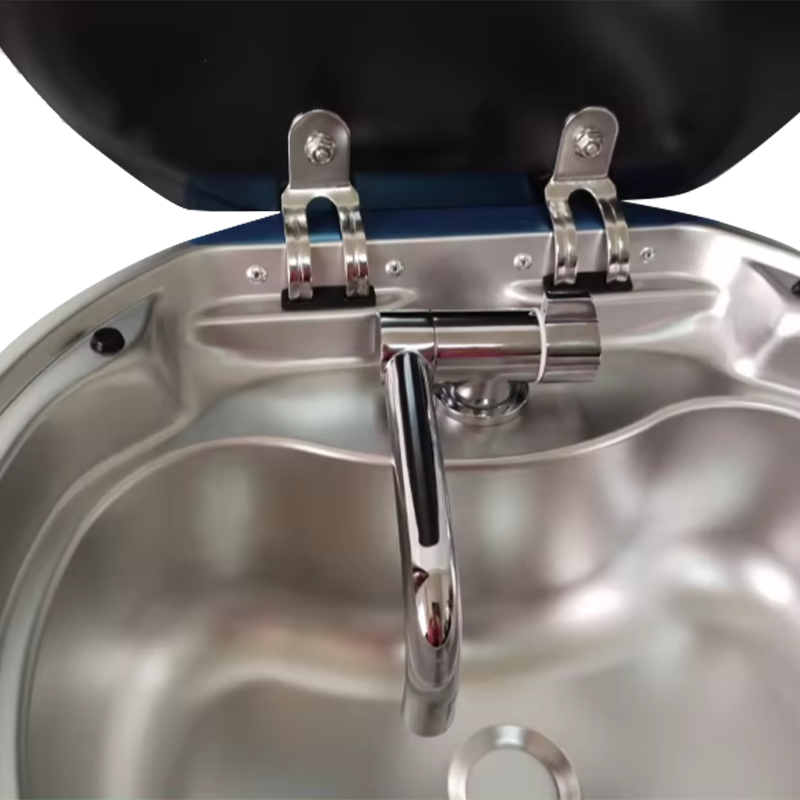 Round Stainless Steel RV Sink and Cooker with GlassCompact round 304 stainless steel RV sink/cooker with 0.8 mm body and tempered glass lid; suits tight mobile kitchens.View Product →
Steel Grade, Thickness and Draw Depth
Almost every covered RV sink is made from 304 stainless steel, and sheet thickness is where budget units give themselves away. A bowl pressed from 0.6 mm dents at the rim and drums under a running tap, while 0.8 mm to 1.0 mm holds its shape and accepts a satin or polished finish more evenly. If a supplier quotes a grade but not a thickness, ask again.
Deep drawing matters more than most buyers expect. A bowl formed in a single draw has no welded corners to trap water or crack along a seam, and it keeps a consistent wall thickness from rim to base. Draw depth and blank diameter are the two figures that decide which bowl shapes a factory can really produce, so it is worth asking for both rather than accepting a general claim about quality.
Drain, Faucet and Water Supply Around a Folding Sink
The mechanism above the counter gets the attention, but the installation is decided below it. A folding sink often sits in a shallower cabinet than a domestic bowl, which limits trap choice. Measure from the underside of the bowl to the cabinet floor, then add the depth of the trap and the fall of the waste pipe. Where the sink sits above a wheel arch or a water tank, a low-profile or swivel trap is usually the only workable answer.
The faucet is the second constraint. A lid that closes flush needs a spout that disappears, so folding, retracting or wall-mounted models dominate this layout. Check the folded height against the closed lid and leave clearance for the lid to open fully without hitting a window, a wardrobe door or a raised roof panel.
Water supply is easy to overlook on a retrofit, especially when a sink is added to a van that never had one. The route from the tank, the pump rating and the way the feed reaches the tap all shape how the finished installation behaves, and a short read on how water reaches an RV sink is a sensible starting point before you commit to a layout.
Combination Units and Custom Sizes
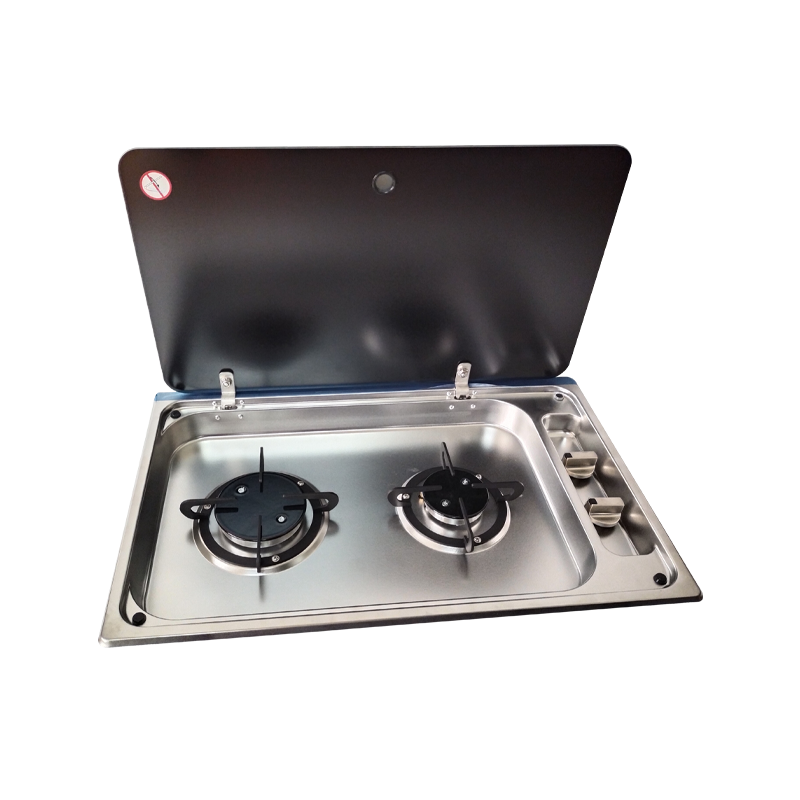
When the counter is genuinely tight, the biggest saving comes from combining functions instead of shrinking the bowl. A one-burner hob and sink under a single glass panel can replace two separate appliances, and a two-burner version keeps a usable cooking surface while still covering everything when the vehicle is moving. The lid then works as a splash guard, a worktop and a travel cover at the same time.
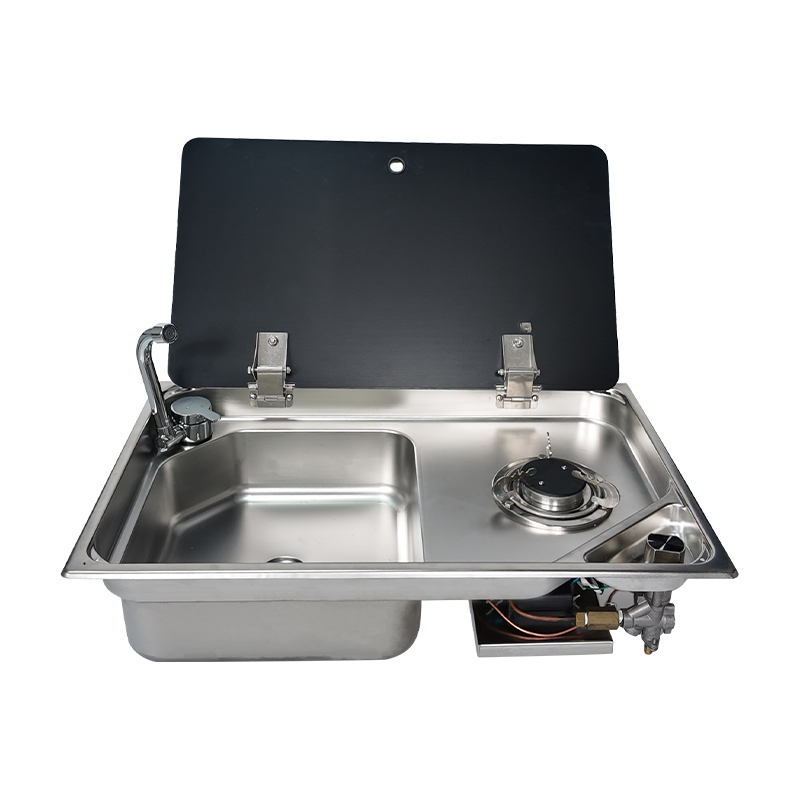
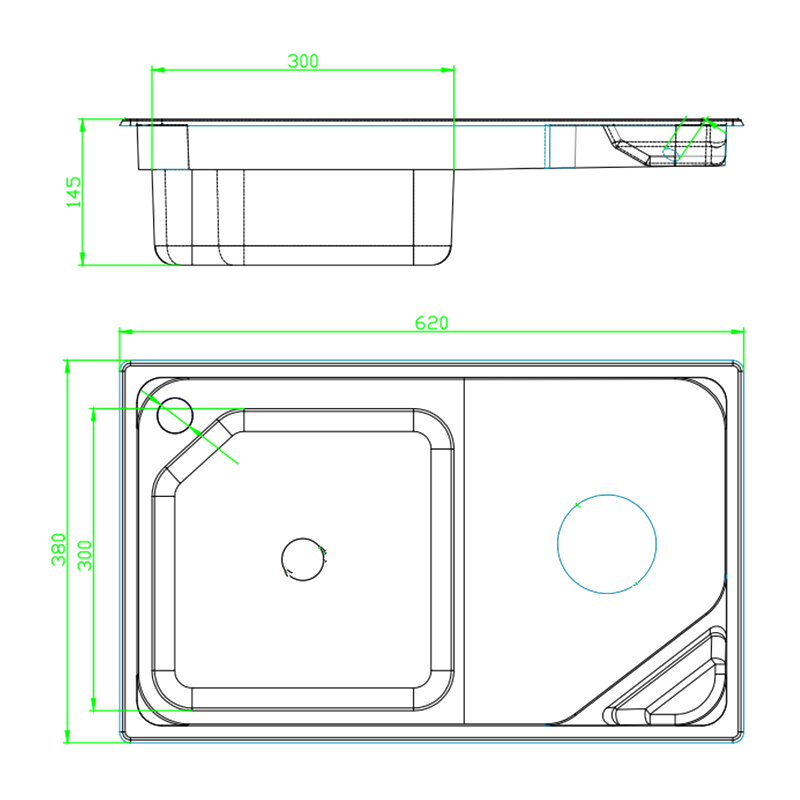 Integrated Campervan Hob and Sink Combi with Glass LidSpace-saving 304 stainless steel hob and sink combination with tempered glass lid; 1 mm body and listed cutout suit campervan or marine galley builds.View Product →
Standard cutouts do not always match real cabinets, particularly in older conversions, boats and one-off builds. When that happens the sink has to be made to the drawing rather than picked from a catalogue: the bowl is drawn, the rim is trimmed, the lid is cut and the tap hole is positioned to suit. Working with a manufacturer that handles stamping, deep drawing and metal fabrication under one roof removes the usual mismatch between a bought-in bowl and a separately sourced lid.
The practical limits to verify are press capacity and draw ratio. Equipment spanning roughly 4T to 1000T, deep drawing to about 450 mm deep and 1000 mm in diameter, plus an in-house tool shop, decide whether a custom covered sink is a straightforward order or an expensive project. Certification such as ISO 9001:2015 sets a baseline for repeatability when a batch has to match an approved sample.
Buying Checklist for a Folding RV Sink
- Confirm the countertop cutout and rim width, not just the nominal bowl size.
- Check the folded height of the faucet against the closed lid, plus the arc needed to open the lid fully.
- Measure cabinet depth for the trap, the waste pipe fall and any wheel arch above.
- Get the steel grade and sheet thickness in writing, along with the draw depth of the bowl.
- Ask how the lid seals, whether by gasket, latch or gravity, and whether it rattles while driving.
- Identify the wear parts, hinges, latches and seal, and confirm replacements are available.
- Agree the tolerance on the cutout and tap hole, because a millimetre or two decides whether the lid sits flush.
A folding RV sink is a space decision more than a washing-up decision. Get the cutout, the trap clearance and the folded faucet height right, and the sink disappears into the counter whenever it is not in use. Get them wrong, and it becomes the one fitting in the galley that never quite closes.
related products
Send An Inquiry
Don't hesitate to contact when you need us!
Whether you want to become our partner or need our professional guidance or support in product selections and problem solutions, our experts are always ready to help within 12 hours globally
contact Us
Phone: +86 18157484296
FAX: +86 574-86150176
E-mail: [email protected]
Address: Unit 2, Building 19, Zhichuangzhizao Park, Chengdong Industrial Zone, Xiangshan, Ningbo,315705, Zhejiang, China
Product Category
Mobile