中文简体
中文简体 Español
Home / Resources / Industry News / RV Kitchen Sinks: Sizes, Materials and Buying Tips for Campers and Boats
Industry News
Sep 04,2026
RV Kitchen Sinks: Sizes, Materials and Buying Tips for Campers and Boats
Content
- 1 Why an RV Kitchen Sink Is Not a House Sink
- 2 Measure First: Width, Cutout and Layout
- 3 304 Stainless Steel and Stock Thickness
- 4 Bowl Depth and Usable Capacity
- 5 Combo Units: Hob and Sink in One Module
- 6 How Sink Materials Compare
- 7 What Good Manufacturing Looks Like
- 8 Installation: Water Supply and Drainage
- 9 Working With a Manufacturer
A sink that misses its cutout by ten millimetres, or a thin bowl that drums every time the pump cycles, will annoy you on every trip. Three decisions prevent most of that trouble: pick a cutout size that matches the counter module, insist on 304 stainless steel, and choose a one-piece drawn bowl over an assembled one. Once those are locked, the remaining choices, from glass lids to stove combinations, are layout questions rather than technical ones.
Why an RV Kitchen Sink Is Not a House Sink
A house sink assumes a 600 mm cabinet, mains pressure and a building that never moves. None of that holds in a camper, caravan or boat. Counter modules shrink to somewhere between 300 and 600 mm, water arrives from a 12 volt pump fed by a modest tank, and the whole assembly shakes for hours on the road. An RV kitchen sink therefore has to stay light for the payload budget, rigid under vibration, and resistant to condensation, spillage and road salt. It also has to work with a low-flow faucet, because the water system, not the sink, sets the flow.
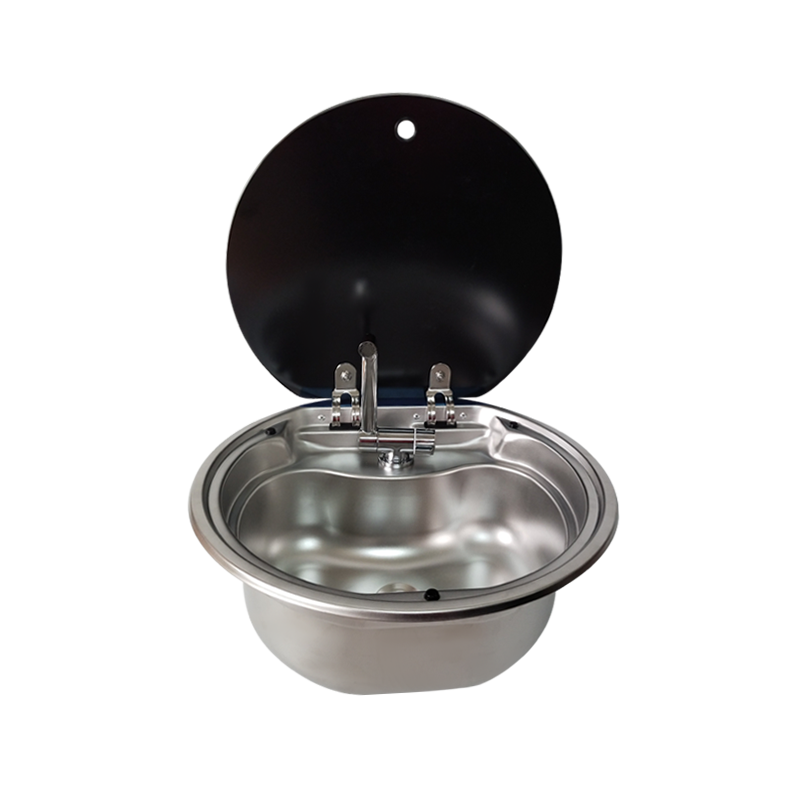
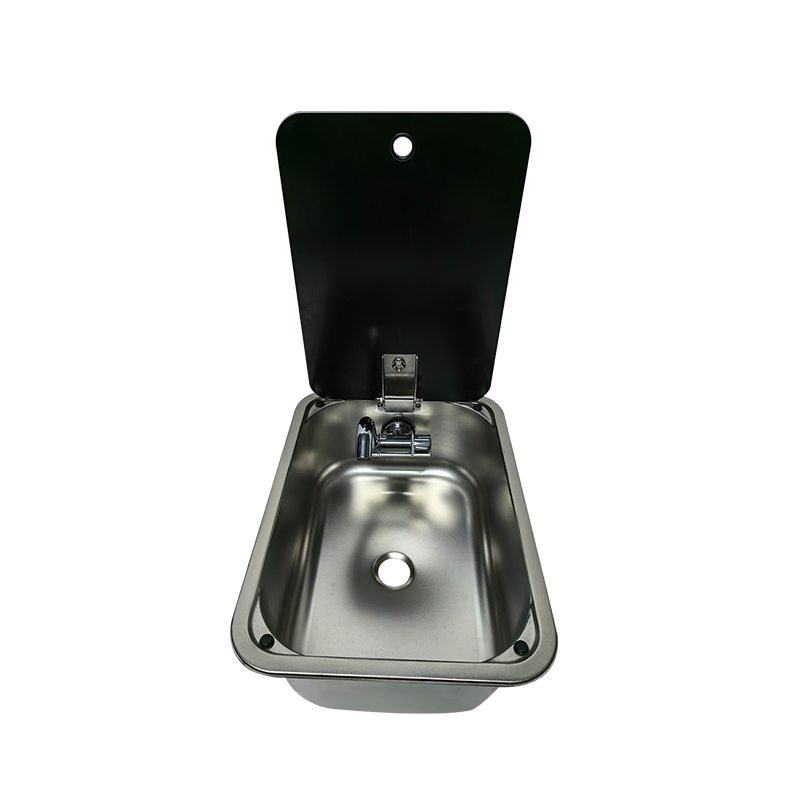
Where space is tightest, such as camper vans, small boats or a dedicated wash corner, a compact round basin is often all the kitchen needs, and it leaves the rest of the counter free for prep work.
 Compact Round Stainless Steel RV SinkA small round stainless steel basin suited to camper vans, boats and tight wash corners. Its compact footprint leaves counter space free, and controlled tooling keeps cutout dimensions tight for cramped galleys.View Product →
Measure First: Width, Cutout and Layout
Before comparing anything else, take one measurement: the distance from the edge of the counter module to the nearest obstacle, whether that is a wall, a window frame or the cooker. That number, not a brochure photo, decides which sinks are realistic candidates. Keep outer size and cutout size apart as well: the outer size includes the mounting flange, the cutout is the hole in the counter, and the flange adds material on every side of the bowl. A maker that controls its own tooling holds cutout dimensions to one or two millimetres, which is exactly the tolerance a cramped galley needs.
Typical cutout widths by sink format
The bars above compare the typical cutout width each sink format needs, from a 280 mm round basin up to a 560 mm two-burner combo. Cutout width is the hole you must cut in the counter, so it is the single dimension that decides whether a sink physically fits your module. Most RV builders work with counter modules between 300 and 600 mm, which is why combination units cluster at the top of the scale. If your available width sits between two formats, remember that the flange usually adds 10 to 15 mm on each side, so leave clearance rather than cutting it close. Always measure the widest point of the unit, including the faucet ledge and any lid hinge, before you commit to a cutout.
| Sink format | Typical cutout width | Best suited for |
|---|---|---|
| Round wash basin | 260 to 300 mm | Camper vans, boats and compact wash corners |
| Round cooker sink | 320 to 360 mm | Small rigs that need a hob and bowl in one unit |
| Rectangular single bowl | 380 to 430 mm | Full galleys built around one counter module |
| Stove and sink combo | 460 to 590 mm | Motorhomes and yachts with a larger counter run |
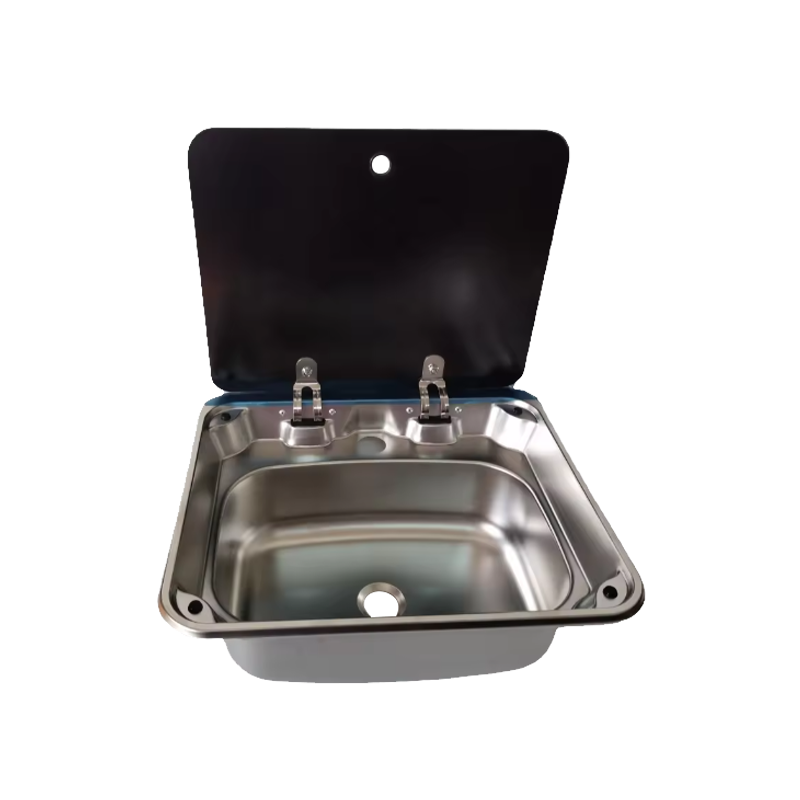
For a full galley built around a single counter module, the rectangular single bowl with a glass cover is the workhorse format. The lid turns the sink into a flat work or drainer surface whenever it is not in use, which recovers counter space that a bare bowl would waste.
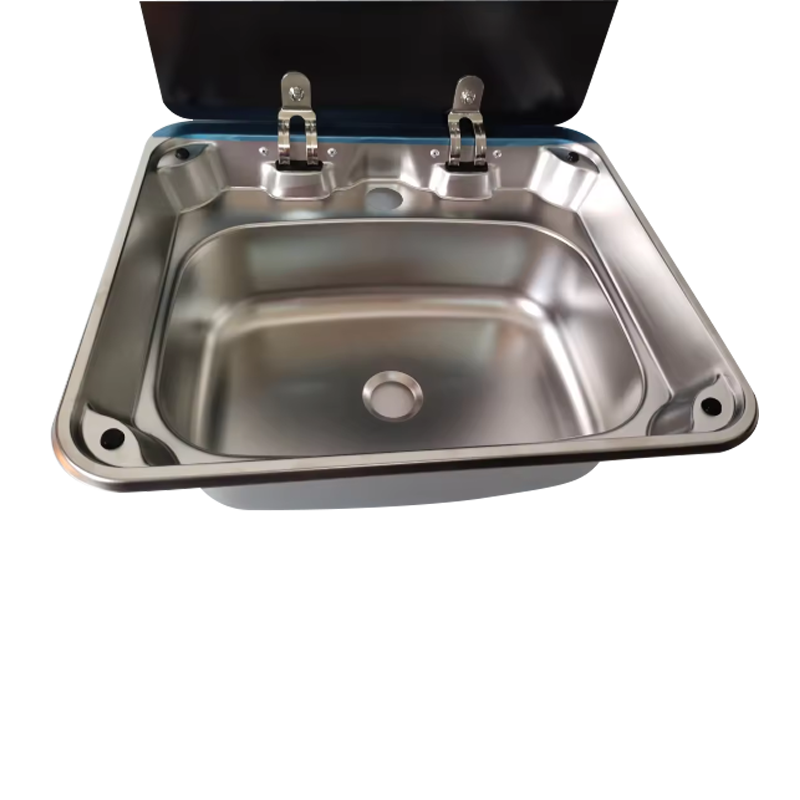 304 Stainless Steel Rectangular Single Bowl RV Sink with Glass CoverThis 470 x 430 mm single bowl in 304 stainless steel includes a glass lid that turns the sink into a flat work or drainer surface, recovering counter space in a full galley built around one module.View Product →
304 Stainless Steel and Stock Thickness
304 stainless steel, an austenitic grade with roughly 18 percent chromium and 8 percent nickel, is the default RV sink material for practical reasons. Chromium forms a passive oxide layer that repairs itself after scratches, which matters in a bowl that receives dropped pans, food acids and cleaning chemicals while sitting in a damp, salty environment. The grade does not rust in normal kitchen service, does not absorb odors and tolerates boiling water and hot pans without deforming.
How stock thickness changes weight and stiffness
Gauge, the thickness of the sheet the bowl is drawn from, decides how the sink feels and sounds. Thin stock flexes, dents and amplifies pump noise, while heavier stock stays rigid and quiet at the cost of payload.
Indicative sink weight versus steel thickness
The line above shows how the weight of a typical drawn single-bowl sink climbs as the steel gets thicker. Moving from 0.7 mm to 1.2 mm stock adds roughly a kilogram, which matters when a build budget counts every gram. Thicker material also means a stiffer bowl that resists oil-canning and transmits less drumming noise from running water. Below about 0.8 mm, bowls can feel flimsy and dent under a dropped pan, while above 1.2 mm the weight penalty is rarely worth it in a vehicle. For most RV and marine kitchens, 0.9 to 1.2 mm of 304 stainless steel is the practical sweet spot.
Bowl Depth and Usable Capacity
Bowl depth is where capacity, splash control and cabinet space collide. A deeper bowl holds more water and contains splash, but every millimetre of depth is taken from the under-counter volume that must fit the fresh tank, pump and drain loop. Most drawn RV bowls land between 140 and 200 mm deep, usually with a pressed drain recess. If the cabinet is shallow, check the total depth including the tailpiece before ordering.
Usable bowl volume versus bowl depth
The columns above show the usable volume of a typical 330 x 280 mm drawn bowl as depth increases. Going from 140 mm to 200 mm deep adds around five litres, which is the difference between rinsing one pot and washing a full set of dishes. Depth also controls splash, because a deeper bowl keeps water in the sink when tap pressure drops or the pump pulses. The trade-off is under-counter space, since every extra millimetre of depth is stolen from the cabinet that holds your tank, pump and drain plumbing. In compact rigs, 140 to 160 mm is common, while larger motorhomes and galleys usually justify 180 mm or more.
Combo Units: Hob and Sink in One Module
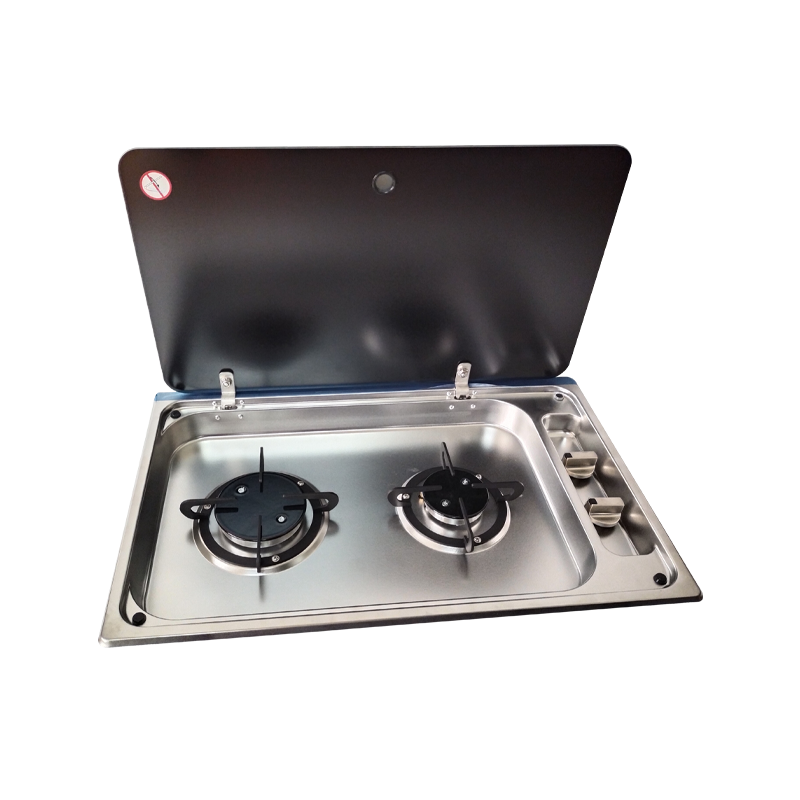
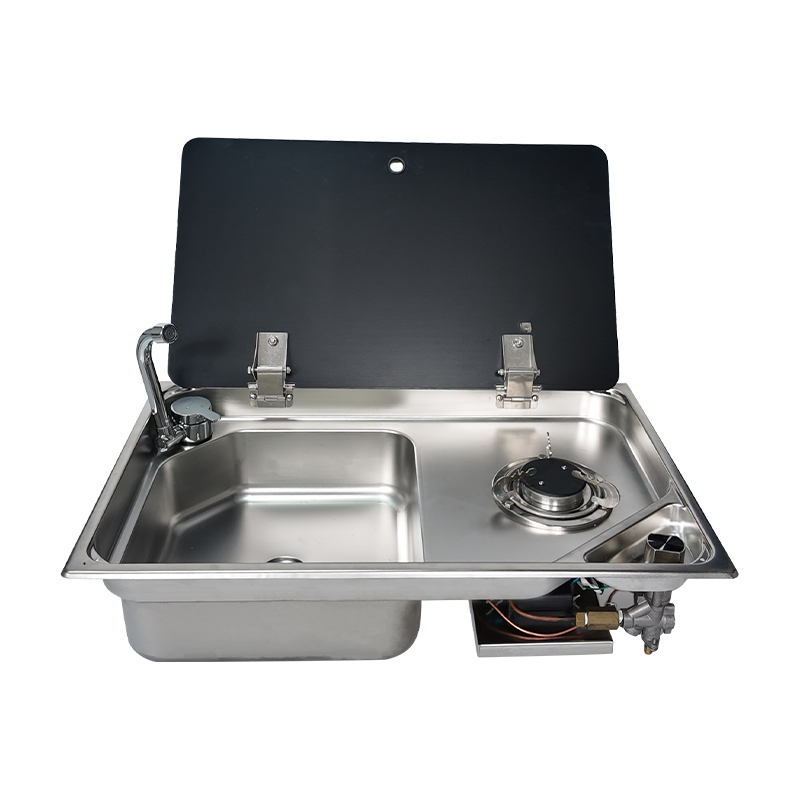
When the counter run is too short for a separate hob and sink, combination units earn their place. A cooker sink pairs a burner with a bowl under a single flange, and a hinged glass cover closes over both so the unit becomes flat work surface when it is not needed. That layout is common in camper vans and small yachts where every centimetre counts. Check three details before buying: the spacing between burner and bowl rim, a raised edge or splash guard on the cooking side, and whether the glass cover is toughened and rated for the heat it sits above.
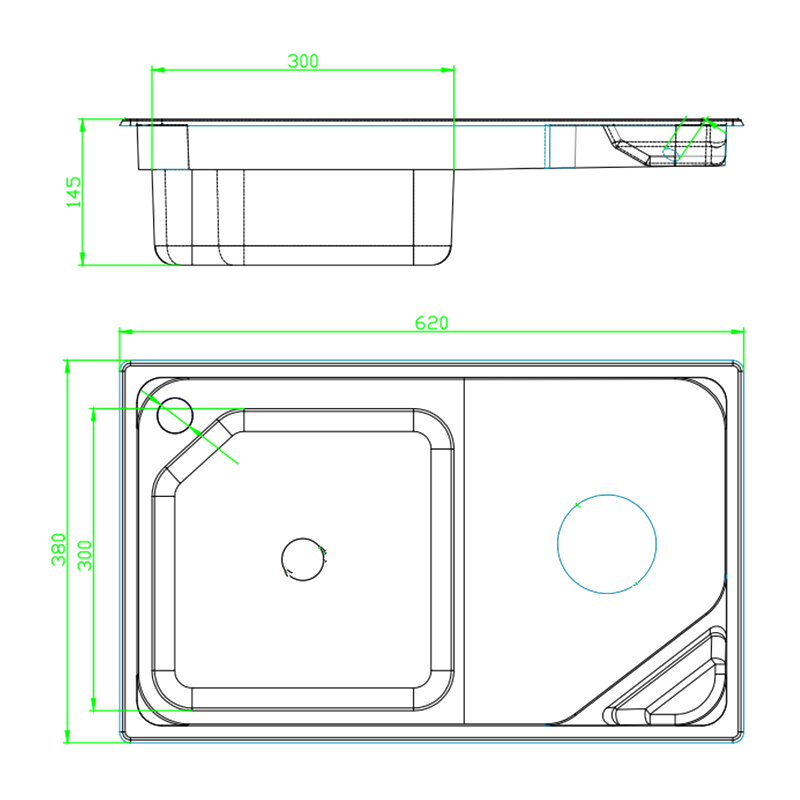 Integrated Campervan Hob and Sink Combo with Glass LidCombining a burner and a bowl under one flange, this 620 x 380 mm 304 stainless steel unit saves counter space where a separate hob and sink will not fit, with a toughened glass cover for flat storage.View Product →
How Sink Materials Compare
Buyers often ask whether stainless steel is worth the premium over acrylic or coated steel. In a stationary kitchen the answer can go either way. In a vehicle that vibrates, heats up in the sun and sees salt spray, it usually cannot.
Material comparison for RV kitchen sinks
304 stainless steel Acrylic Coated steel
The radar chart above rates three common sink materials on the six factors that matter most in a moving vehicle. 304 stainless steel leads on corrosion resistance, heat tolerance and hygiene, and it tolerates hot pans and boiling water without deforming. Acrylic scores well on weight and cost but softens near heat, scratches visibly and can crack at the drain over time. Coated steel sits in the middle on price, yet once the coating chips, the base metal rusts quickly around the drain and edges. These ratings are qualitative and based on typical RV service conditions rather than laboratory figures. For anything that handles food waste and hot water daily, the stainless profile on the chart is the one that matters.
What Good Manufacturing Looks Like
Whatever the format, sink quality is decided at the drawing press, not at the assembly bench. A good bowl is deep drawn from a single blank, so there are no welded corner seams to collect grime or split under vibration. Look for a uniform corner radius, an even satin polish, a flat mounting flange and a drain hole cut concentric with the recess. These details come from tooling quality, which is why it pays to buy from a manufacturer that builds and maintains its own dies. Our workshop runs presses from 4 to 1000 tons, draws stainless parts to 450 mm depth and 1000 mm diameter, and works under an ISO9001:2015 certified quality system, so cutout dimensions and flange flatness are controlled outcomes rather than hopes.
Installation: Water Supply and Drainage
Plumbing an RV sink is simple once the water system is respected. Supply comes from the fresh tank through a 12 volt pump, so the faucet is low-flow and the tailpiece should accept a flexible hose without stressing the drawn bowl. Seal the cutout with a continuous bead of silicone, support the bowl underneath so vibration cannot work the seal loose, and fit a strainer that can be cleared on the road. If the system is being designed from scratch, the guide to what supplies water to the RV sink walks through the tank, pump and faucet loop step by step.
Working With a Manufacturer
If none of the standard formats fit the module, sinks can be made to specification, and the process stays simple when both sides work from drawings.
Specifying a custom sink in three steps
- Send a dimensioned drawing or a sample of the existing sink, including cutout size, depth, drain position and faucet holes.
- Confirm the material grade and stock thickness in writing, ideally with a material certificate for the 304 sheet.
- Agree the finish, lid type and packaging, then approve a first article before volume production starts.
Because tooling, stamping, deep drawing, polishing and assembly all happen in-house, changes between these steps stay fast, and the tooling that produced the first article supports repeat orders at stable quality. For standard formats, browse the complete RV sink range to compare basins, cooker sinks and stove combinations side by side before committing to a cutout.
Replacement Kitchen Sink for RV: How to Measure, Choose and Install the Right One
Can a hob-sink combo improve kitchen efficiency?
related products

Send An Inquiry
Don't hesitate to contact when you need us!
Whether you want to become our partner or need our professional guidance or support in product selections and problem solutions, our experts are always ready to help within 12 hours globally
contact Us
Phone: +86 18157484296
FAX: +86 574-86150176
E-mail: [email protected]
Address: Unit 2, Building 19, Zhichuangzhizao Park, Chengdong Industrial Zone, Xiangshan, Ningbo,315705, Zhejiang, China
Product Category
Mobile