中文简体
中文简体 Español
Industry News
Jun 19,2026
How Do Pallet Feet & Nesting Plugs Improve Stackability?
Content
- 1 The Mechanics of How Nesting Plugs Lock Pallets Into Alignment
- 2 Controlling the Nesting Increment: How Much Space Is Actually Saved
- 3 Load Distribution and Structural Stability During Stacking
- 4 How Foot Height Uniformity Affects Stack Levelness
- 5 Stackability Performance Across Different Pallet Foot Configurations
- 6 Material Choice and Its Impact on Stacking Performance Over Time
- 7 Stackability in Automated Warehouse Environments
- 8 How Nesting Plug Design Affects Ease of De-Stacking
- 9 The Effect of Stacking on Pallet Fleet Management
- 10 Key Specifications to Define for Optimal Stackability
Pallet feet and nesting plugs improve stackability by creating a precise mechanical interlock between stacked pallets that prevents lateral shifting, controls the vertical increment of each additional pallet, and distributes compressive loads evenly across defined contact points. The result is a stacking system that is structurally stable, space-efficient, and safe to handle — qualities that flat-sheet pallets without these components cannot reliably achieve on their own.
At Ningbo Dasheng Metal Products Co., Ltd, we manufacture pallet feet and nesting plugs through precision metal stamping, deep drawing, and welding processes. Our direct involvement in producing these components gives us a detailed understanding of how dimensional accuracy and material quality translate into real-world stackability performance. The following article examines every aspect of how these two components work together to transform pallet stacking from an unreliable manual task into a controlled, repeatable, and measurable operation.
The Mechanics of How Nesting Plugs Lock Pallets Into Alignment
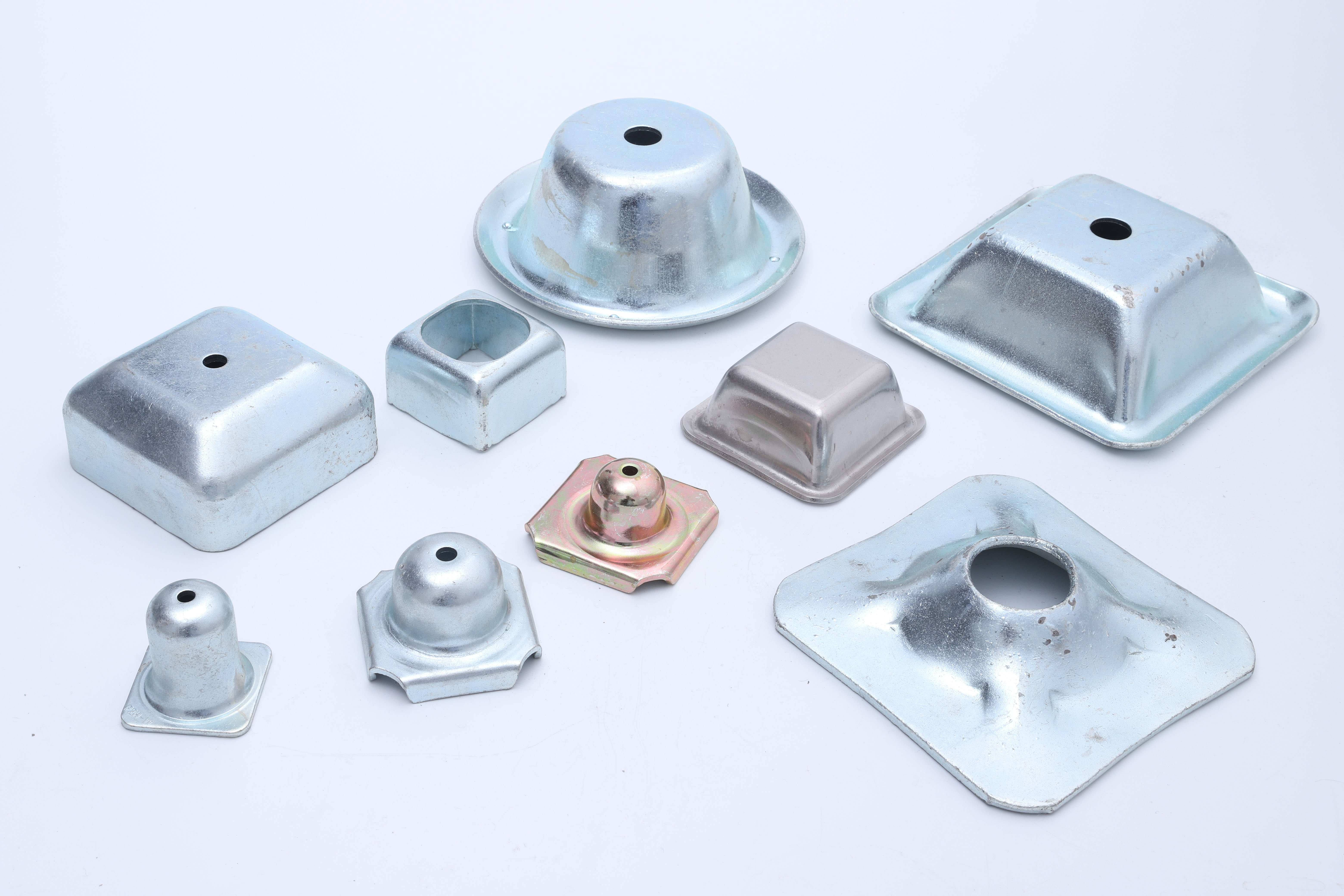
The fundamental mechanism by which pallet feet and nesting plugs improve stackability is the plug-into-foot engagement. When an empty pallet is placed on top of another, the nesting plugs protruding from the underside of the upper pallet descend into the open cavities at the top of the feet on the lower pallet. This engagement does three things simultaneously: it positions the upper pallet in precise horizontal alignment with the lower one, it limits how far the upper pallet can descend into the lower (controlling the nesting increment), and it resists any lateral force that would otherwise cause the stack to shift or lean.
Without nesting plugs, stacked pallets have no mechanical connection to each other. They rely entirely on gravity and friction to stay in position. On smooth warehouse floors, during forklift handling, or in moving vehicles, friction alone is insufficient to prevent shifting. A stack of ten pallets without interlocking components can shift laterally by several centimeters under modest lateral acceleration — enough to topple the stack or make it unsafe to lift as a unit.
Plug Geometry and Its Effect on Stack Precision
The geometry of the nesting plug — its taper angle, outer diameter, wall thickness, and height — determines how precisely the upper pallet seats relative to the lower one and how much lateral play exists within the engaged stack. A plug with a generous entry taper (typically 3° to 7° of draft angle) guides the pallet into position even when placement is not perfectly centered, while a tighter fit at the base of the engagement provides the precision alignment that automated handling systems require. Precision-stamped plugs manufactured to tight dimensional tolerances achieve positional repeatability within ±1 mm — essential for pallets handled by robotic systems or automated guided vehicles.
Controlling the Nesting Increment: How Much Space Is Actually Saved
One of the most quantifiable ways in which pallet feet and nesting plugs improve stackability is by enabling a controlled and predictable nesting increment — the additional vertical height added to a stack by each successive pallet. This increment is determined by the difference between the total height of the pallet foot and the depth to which the nesting plug engages inside it.
A well-engineered nesting system typically achieves a nesting increment of 30 to 60 mm per pallet. By comparison, a conventional wooden block pallet with a total height of approximately 145 mm adds the full 145 mm to a stack with every additional unit — because it has no nesting capability at all. The space-saving implications are dramatic:
| Number of Pallets | Conventional Pallet Stack Height (145 mm each) | Nestable Pallet Stack Height (40 mm increment) | Space Saved |
|---|---|---|---|
| 5 | 725 mm | 310 mm | 57% |
| 10 | 1,450 mm | 510 mm | 65% |
| 20 | 2,900 mm | 910 mm | 69% |
| 50 | 7,250 mm | 2,110 mm | 71% |
As the table shows, the space-saving benefit increases as more pallets are stacked, because the fixed base height of the bottom pallet becomes a smaller proportion of the total stack height. At 50 pallets, a nestable system with a 40 mm increment occupies less than 30% of the space required by conventional pallets — a transformation that directly affects how many empty pallets a warehouse can store, how many can be loaded onto a return truck, and how efficiently a pallet pool can be managed.
Why Precise Nesting Increment Control Matters
Consistent nesting increment control is only possible when pallet feet and nesting plugs are manufactured to precise dimensional specifications. If foot heights vary by several millimeters across a pallet fleet — as they will when components are produced with insufficient quality control — the nesting increment becomes unpredictable. Some pallets will nest deeper than intended, potentially causing the pallet deck to contact and damage goods on a loaded pallet below. Others will not nest at all if the plug fails to engage the foot cavity properly. Dimensional consistency across every component in the fleet is the foundation of reliable stackability.
Load Distribution and Structural Stability During Stacking
Stackability is not only about how compactly pallets nest — it is also about how safely and stably they bear loads when stacked with goods. Pallet feet play a central role in this by defining exactly where compressive forces are transmitted between stacked pallets and to the floor. In a multi-pallet stack carrying loaded pallets, the feet of each upper pallet must transfer their load directly onto the structural elements of the pallet below — not onto the deck surface between feet, which in most pallet designs is not engineered to carry compressive loads from above.
Precision-positioned feet ensure that load transfer occurs at the correct points in every stacking configuration. When feet are consistently placed at the corners and edges of the pallet — as they are in a well-designed system with controlled manufacturing tolerances — each level of a loaded stack is supported by the structural columns formed by the feet below it. This column-like load path is mechanically efficient and prevents the bending and flexing of pallet decks that occurs when loads are transferred to unsupported areas.
The Role of Nesting Plugs in Preventing Stack Collapse
When a loaded pallet stack is subjected to horizontal forces — from a vehicle rounding a corner, a forklift decelerating sharply, or seismic activity in a warehouse — the tendency of the stack is to lean and potentially topple. Nesting plugs that engage positively in pallet feet resist this tendency by acting as shear connectors between adjacent pallets. The plug's contact with the inner wall of the foot cavity converts lateral force into a compressive and tensile interaction between the two components, dissipating the energy rather than allowing the pallets to slide relative to each other.
The shear resistance provided by a single plug-foot engagement depends on the wall thickness of both components, the depth of engagement, and the material properties of each part. A pressed steel plug engaging a steel foot cavity provides significantly greater shear resistance than a plastic plug in a plastic foot — an important consideration for operations where stacked pallets are transported by truck over long distances on imperfect road surfaces.
How Foot Height Uniformity Affects Stack Levelness
A pallet stack is only as level as the feet supporting it. If the four or more feet on a single pallet vary in height — even by a few millimeters — the pallet deck will not sit level on the pallet below it. This tilt accumulates with each additional pallet in the stack: a 2 mm height variation per pallet becomes a 20 mm lean across a ten-pallet stack, which is sufficient to make the top pallet visibly unstable and potentially unsafe to pick up as a unit with a forklift.
Controlling foot height uniformity across a pallet fleet requires manufacturing processes capable of producing components to tight height tolerances — typically ±0.5 mm or better for precision applications. At Ningbo Dasheng Metal Products Co., Ltd, our deep drawing and stamping operations are conducted with tooling that maintains consistent material flow and forming depth, ensuring that every foot produced in a production run meets the specified height within the required tolerance. This consistency is verified through in-process quality checks rather than relying on end-of-line inspection alone.
Foot Geometry and Its Effect on Level Contact
Beyond height, the flatness and squareness of the foot's base contact surface also affect stack levelness. A foot with a warped or non-flat base will rock on the surface below it rather than making stable, uniform contact. This rocking behavior under load creates stress concentrations at the edges of the contact area, accelerating wear and increasing the risk of foot deformation over time. Precision-formed metal feet, produced by dies that control the flatness of the contact surface within specified limits, eliminate this problem by ensuring that every foot sits stably and transfers load uniformly across its entire base area.
Stackability Performance Across Different Pallet Foot Configurations
Not all pallet foot configurations deliver the same stackability performance. The number of feet, their placement pattern, their individual geometry, and the number of nesting plugs engaged per pallet all influence how the system performs under real operating conditions. Understanding the trade-offs between common configurations helps specify the right design for a given application.
| Foot Configuration | Number of Feet | Stack Stability | Nesting Increment | Typical Application |
|---|---|---|---|---|
| 4-corner | 4 | Good | Low (30–40 mm) | Light loads, retail distribution |
| 6-point (4 corners + 2 center edge) | 6 | Very Good | 35–50 mm | Standard industrial, food service |
| 9-point (3×3 grid) | 9 | Excellent | 40–60 mm | Heavy loads, automotive, racking |
| Runner / continuous rail | 2–3 rails | Good (directional) | 50–70 mm | Conveyor systems, cold chain |
The 9-point configuration delivers the best overall stackability because it maximizes the number of interlocking plug-foot engagements per pallet, distributes load across the largest number of contact points, and minimizes deck deflection between feet. However, it also results in a slightly higher nesting increment than a 4-corner system, because more foot material must be accommodated in the stacking gap. The optimal configuration for any given operation depends on the balance between load capacity requirements, nesting efficiency targets, and the dimensional constraints of the handling equipment.
Material Choice and Its Impact on Stacking Performance Over Time
The stackability improvements provided by pallet feet and nesting plugs are only sustained over the life of the pallet if the components are manufactured from materials that maintain their geometry under repeated load cycles. Material degradation — creep, fatigue cracking, corrosion, or thermal deformation — changes the dimensional characteristics of feet and plugs in ways that progressively undermine the interlocking precision on which stackability depends.
- Pressed steel feet maintain their geometry under sustained compressive loads without creep, resist impact without fracture, and perform consistently across temperature ranges from -40°C to +300°C. Their dimensional stability over hundreds of load cycles is the highest of any common foot material.
- Stainless steel feet offer the same mechanical stability as pressed carbon steel with the addition of corrosion resistance in wet, food-grade, or chemical environments. They are the preferred choice when pallet stackability must be maintained through repeated washdown cycles.
- High-density polyethylene (HDPE) feet provide adequate stackability for light to medium loads but are susceptible to creep under sustained compressive stress, particularly at elevated temperatures. Over time, a loaded stack can cause HDPE feet to compress permanently, reducing foot height and altering the nesting increment.
- Polypropylene feet are lighter and lower in cost than HDPE but have reduced impact resistance and a higher susceptibility to brittle fracture at sub-zero temperatures. In cold chain environments, polypropylene feet can crack under the shock loads generated during pallet drops or rough handling, eliminating their interlocking function entirely.
- Aluminum alloy feet combine low weight with good dimensional stability and corrosion resistance, making them suitable for applications where pallet weight is a critical constraint — such as air freight or high-frequency manual handling operations.
For operations where stackability must be maintained reliably over 100 or more pallet cycles, pressed or stainless steel feet are the most dependable choice. Their resistance to creep, impact, and temperature variation ensures that the dimensional precision established at manufacture is preserved throughout the component's service life.
Stackability in Automated Warehouse Environments
In manually operated warehouses, a small amount of stack misalignment can be corrected by a worker repositioning pallets. In automated environments — where robotic stackers, automated guided vehicles (AGVs), and conveyor-fed automated storage and retrieval systems (AS/RS) handle pallets without human intervention — there is no correction mechanism. A pallet that does not nest within its specified dimensional envelope will cause a jam, a sensor fault, or a system stoppage that halts the entire operation.
This is why automated logistics operators specify extremely tight tolerances on pallet feet and nesting plugs — often tighter than the standard tolerances used in manual handling applications. Typical requirements for automated systems include:
- Foot height tolerance: ±0.5 mm across all feet on a single pallet and across all pallets in the fleet.
- Nesting plug diameter tolerance: ±0.3 mm to ensure consistent engagement depth and resistance to lateral displacement.
- Foot position tolerance: ±1 mm from the specified position on the pallet deck, to align with robotic pick points and sensor detection zones.
- Stack height repeatability: The total height of a nested stack must be predictable to within ±2 mm per pallet to allow AS/RS systems to position their forks accurately without recalibration between cycles.
- Lateral displacement resistance: A nested stack must resist lateral displacement forces of at least 200 N without the top pallet shifting more than 2 mm relative to the one below it.
Achieving these specifications consistently across large production runs requires the precision manufacturing capabilities that Ningbo Dasheng Metal Products Co., Ltd brings to every component we produce. Our stamping and deep drawing tooling is designed and maintained to the dimensional requirements of each customer's specification, and our quality verification processes confirm that every component leaving our facility meets the tolerances required for its intended application — including the demanding requirements of automated logistics environments.
How Nesting Plug Design Affects Ease of De-Stacking
Stackability improvements are only practically useful if the stack can also be easily and reliably separated when individual pallets are needed. A nesting plug that engages so tightly that it requires excessive force to disengage creates operational problems: increased de-stacking time, higher risk of pallet damage during separation, and difficulty for automated de-stackers to generate the required lifting force without damaging the pallet deck.
The design of a well-performing nesting plug balances three competing requirements:
- Sufficient engagement to resist lateral displacement under the forces experienced during transport and handling — typically requiring a minimum engagement depth of 15–25 mm.
- Controlled clearance between plug and foot inner wall — enough to allow smooth engagement and disengagement without binding, typically 0.5–2 mm of radial clearance depending on the application.
- Draft angle on the plug exterior — a slight taper (3°–7°) that guides the plug into the foot cavity during stacking and facilitates clean disengagement without the suction effect that can occur with parallel-wall plugs in deep cavities.
Getting this balance right requires both thoughtful design and precise manufacturing. A plug that is formed with inconsistent wall thickness or an out-of-round cross-section will behave unpredictably — binding in some orientations and fitting loosely in others. Precision-stamped and deep-drawn plugs, produced from consistent-thickness sheet metal with controlled forming parameters, eliminate this variability and deliver the same engagement and disengagement behavior on every pallet in the fleet.
The Effect of Stacking on Pallet Fleet Management
Improved stackability does not only affect the physical dimensions of a pallet stack — it has direct and measurable effects on the efficiency of pallet fleet management across the entire supply chain. Operations that can stack empty pallets more compactly and more stably gain advantages at every point in the logistics cycle where pallets need to be stored, counted, transported, or retrieved.
Storage Capacity at Dispatch and Receiving Points
At dispatch docks, distribution centers, and manufacturing facilities, empty pallets awaiting loading occupy floor space that could otherwise be used for productive storage. A nestable pallet system that reduces stack height by 65–70% compared to conventional pallets allows the same floor area to hold three to four times as many empty pallets. This directly reduces the frequency of pallet replenishment runs and the labor associated with managing large numbers of individually stored units.
Return Freight Efficiency
Return logistics — moving empty pallets back through the supply chain — is a cost center that scales directly with pallet volume. A standard trailer with an internal height of 2,700 mm can accommodate 18 conventional pallets stacked at 145 mm each. With a nestable system at a 40 mm increment and a 150 mm base height, the same trailer can carry approximately 64 pallets in the same vertical space — more than three times the load. This reduction in return transport trips cuts fuel costs, driver hours, and carbon emissions in direct proportion to the improvement in stacking efficiency.
Reduced Handling Operations per Pallet Cycle
Because nestable stacks are structurally stable and can be handled as a single unit without risk of the individual pallets shifting, forklift operators can move larger quantities of empty pallets in a single lift. A stable stack of 20 nestable pallets can be moved as a unit; 20 conventional pallets without interlocking would require multiple separate moves or the use of specialized equipment. This reduction in individual handling operations reduces labor time, forklift wear, and the risk of handling-related accidents.
Key Specifications to Define for Optimal Stackability
For operations specifying new pallet feet and nesting plugs, or evaluating existing components for stackability performance, the following parameters are the most critical to define and verify:
- Target nesting increment: Define the maximum acceptable vertical height addition per nested pallet, based on the storage and transport space available and the number of pallets expected in each stack.
- Foot height and tolerance: Specify the nominal foot height required to provide adequate forklift entry clearance (minimum 95 mm) and the maximum permissible height variation across all feet on a single pallet (typically ±0.5 mm for precision applications).
- Plug engagement depth: Define the depth to which the nesting plug must engage the foot cavity to provide the required lateral displacement resistance, balanced against the disengagement force that is acceptable for manual or automated de-stacking.
- Plug-to-foot radial clearance: Specify the clearance between the outer wall of the nesting plug and the inner wall of the foot cavity, balancing ease of engagement against the tightness of the positional lock.
- Lateral displacement resistance: Define the minimum lateral force the nested stack must resist without shifting, based on the dynamic forces experienced during transport in the intended vehicle type.
- Material and surface treatment: Select the foot and plug material based on load requirements, temperature range, corrosion exposure, and the number of cycles the components must maintain their dimensional specifications over.
- Configuration and count: Decide on the number and placement pattern of feet based on the pallet's load capacity requirements and the nesting increment target, using the configuration comparison data as a starting reference.
At Ningbo Dasheng Metal Products Co., Ltd, our experienced engineering team works with customers from the specification stage through to production and delivery, ensuring that every parameter governing stackability performance is correctly defined and reliably achieved. From selecting the optimal material and designing the tooling to manufacturing finished components and verifying their dimensional conformance, we provide the technical expertise and manufacturing precision that quality pallet feet and nesting plugs require.
related products
Send An Inquiry
Don't hesitate to contact when you need us!
Whether you want to become our partner or need our professional guidance or support in product selections and problem solutions, our experts are always ready to help within 12 hours globally
contact Us
Phone:+86 139-5824-9488
FAX :+86 574-86150176
E-mail: [email protected] [email protected]
Address: Unit 2, Building 19, Zhichuangzhizao Park, Chengdong Industrial Zone, Xiangshan, Ningbo,315705, Zhejiang, China
Product Category
Mobile