中文简体
 Español
Home / Resources / Industry News / RV Sink With Lid: Glass Covers, Cutout Fit and Sourcing Tips for Van Builds
Industry News
Oct 30,2026
RV Sink With Lid: Glass Covers, Cutout Fit and Sourcing Tips for Van Builds
Content
- 1 Specify the Lid First, Then the Bowl
- 2 What a Lid Actually Does in a Moving Kitchen
- 3 Comparing Common Lid Designs
- 4 Cutout, Rim and Worktop Fit
- 5 Grade, Thickness and Finish Behind the Lid
- 6 Water Supply, Drain and Lid Clearance
- 7 A Practical Checklist Before Approving a Drawing
- 8 Custom Sink Programs and What to Send
Picture a van kitchen at the end of a dusty access road: the lid is down, the counter is clear, and nobody has to scrub a greasy bowl before the coffee goes on. That one small part is why buyers searching for an rv sink with lid usually end up caring more about the cover than about the basin itself. The lid decides how tall the unit stands, how the worktop gets cut, and how much usable prep space survives once the galley is folded away. Choose it late and the bowl cannot be fixed.
Specify the Lid First, Then the Bowl
The lid should be locked in before the bowl is sized, not after. Three things get decided early: the closed height above the counter, the cutout and rim width, and the way the hinge or strut behaves when the lid is open.
A lid that folds flat back needs clearance behind the sink, often 40 mm to 60 mm, or it will foul the backsplash. A lid that stands upright while you work needs headroom under the overhead locker. A glass lid that closes over a gas burner must be raised before ignition and must carry a heat rating that suits the burner output. Each of these points costs nothing to settle on a drawing and a great deal to settle at first fit, when the worktop is already cut and the sealant is already spread.
What a Lid Actually Does in a Moving Kitchen
A lid earns its place through small jobs that add up over a season of travel:
- Keeps dust, insects and road grit out of the bowl between stops.
- Holds splash in while driving, especially when a drain valve is left slightly open.
- Acts as a splash guard when folded upright behind the tap.
- Provides a flat, tempered surface for light prep when the glass is rated for it.
- Hides dish clutter at camp, which matters in a galley only three or four metres long.
Two details get overlooked. The first is the hinge. A glass pane on a thin frame pulls on two or three small screws, so specify a stainless hinge plate and machine screws rather than self-tapping screws biting into a 20 mm worktop. The second is the strut. Gas struts make a heavy lid feel light but add a service item that can lose pressure; friction hinges are simpler but may loosen after a few thousand open and close cycles. Decide which compromise you can live with.
Comparing Common Lid Designs
| Lid design | Typical construction | How it opens | Good fit for | Check on arrival |
|---|---|---|---|---|
| Framed glass lid | Tempered pane in a stainless frame, rear hinge | Folds back flat or stands upright | Single bowl basins in camper galleys | Hinge screws and clearance to the backsplash |
| Safety glass lid over a hob | Tempered glass with a heat resistant seal | Lifts and locks open before ignition | Combined one or two burner and sink units | Heat rating and whether a safety cut-off is fitted |
| Stainless hinged lid | Pressed 304 sheet with a folded edge | Swings back, sometimes removable | Wet or rugged use, boat galleys | Lid weight, hinge rattle, drain hole in the lid |
| Integrated cover and board | Glass or steel lid with a flat top face | Lifts off or slides | Small vans where the lid doubles as prep space | Flatness, anti slip surface, storage when removed |
| Open bowl, no lid | Rim only, sometimes a loose cover | Not applicable | Budget builds and utility trays | Splash control while travelling |
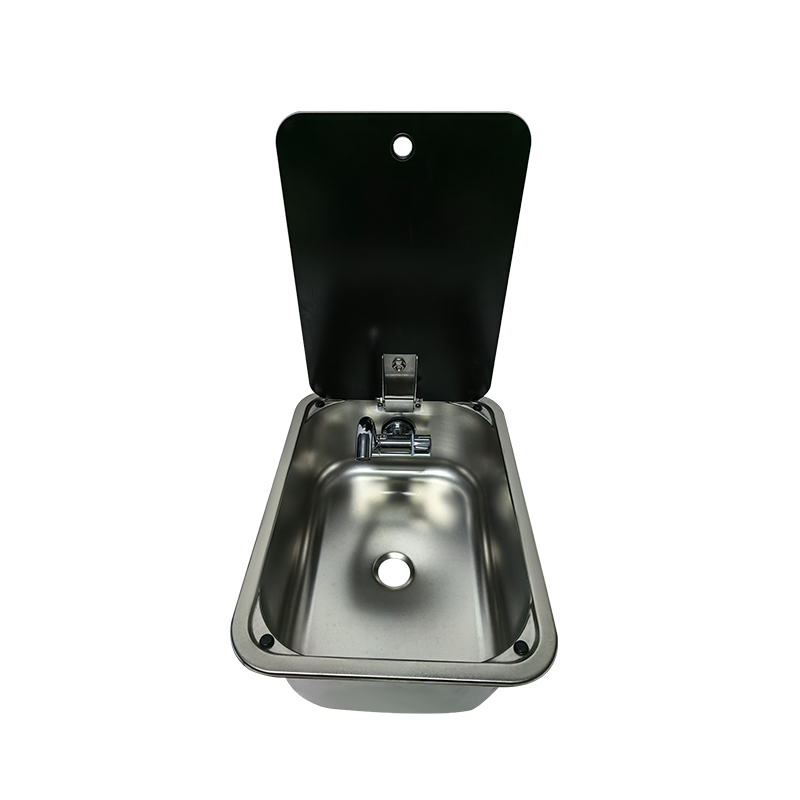
For a single bowl unit with a framed glass top, a 304 stainless cooker sink with a hinged glass cover is the usual reference point: a deep drawn bowl, a lid that folds back out of the way, and a rim wide enough to sit on a 25 mm to 30 mm worktop.
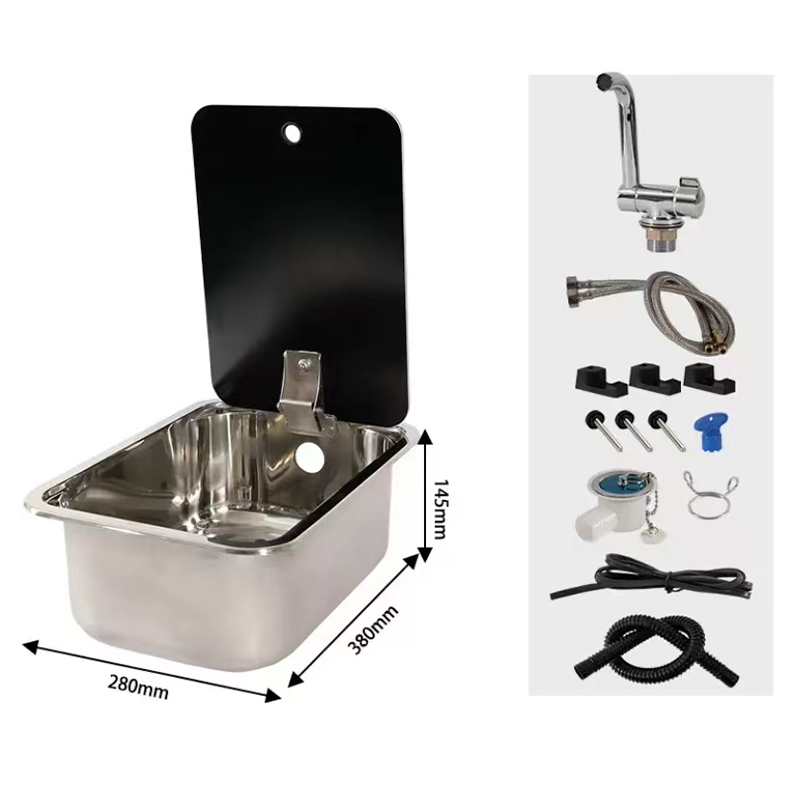 304 Stainless Steel RV Cooker Sink with Glass CoverA 304 stainless cooker sink with tempered glass cover, measuring 380 x 280 x 145 mm, suited to single-bowl framed glass galley installations.View Product →
Cutout, Rim and Worktop Fit
The cutout is set by the rim, not by the bowl. Bowl openings of roughly 300 mm by 350 mm up to 400 mm by 450 mm are common in leisure vehicle galleys, and rim widths usually run 15 mm to 25 mm. That rim is the tolerance band. Cut the hole 1 mm to 2 mm oversize and the sealant line becomes the only defence against water reaching the core of a plywood or composite top.
Specify the cutout drawing with an allowed tolerance, typically plus or minus 0.5 mm on stamped rims, and check corner radii against the router bit or jigsaw blade you actually own. A square corner on a drawing and a 12 mm radius on site is how leaks begin. Also confirm the drop below the counter: a bowl 150 mm to 180 mm deep plus a trap needs room, and the lid adds another 20 mm to 40 mm above the surface when closed.
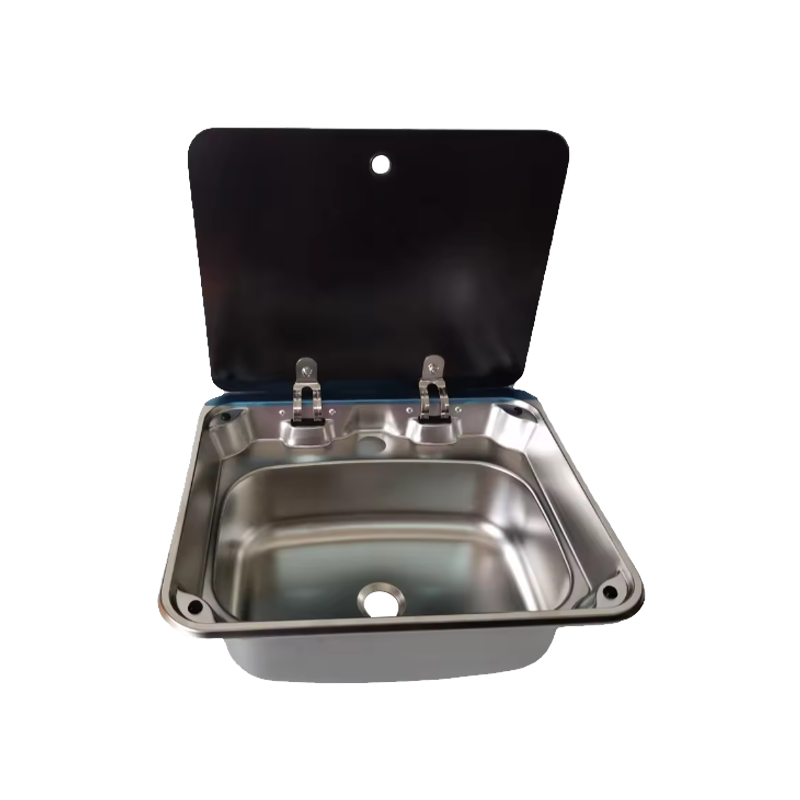
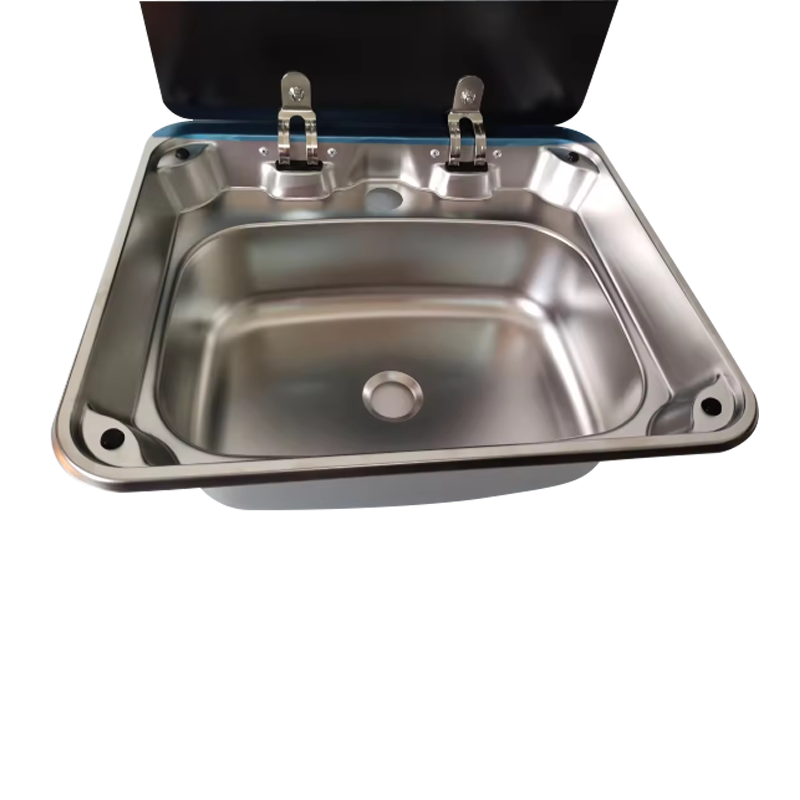 304 Stainless Steel Rectangular RV Sink with Glass PanelA single-bowl rectangular stainless sink with tempered glass cover, 470 x 430 x 210 mm, suited to narrow caravan and motorhome counters.View Product →
A rectangular single bowl with a glass lid suits narrow counters where a round basin would waste the corner space, provided the rim lands on solid material rather than the edge of a hatch.
Grade, Thickness and Finish Behind the Lid
304 stainless is the sensible baseline for a wet, salty environment. Lower alloys are cheaper and tend to show pitting sooner, particularly around a hinge where water sits after a wash. Bowl thickness of 0.8 mm to 1.2 mm is normal for leisure vehicle sinks, with the rim either a separate stamped frame or a folded edge on the bowl itself.
Deep drawn bowls keep a continuous grain and avoid a weld seam in the corner, which is exactly where fabricated basins start to leak. On a boat or at a coastal campsite, a polished or lightly brushed finish is easier to live with than a mirror polish that shows every fingerprint. Condensation is the other factor: a cold stainless bowl under a closed glass lid beads water on the underside, so a small vent gap, or simply leaving the lid folded back after washing, saves a wipe-down every morning.
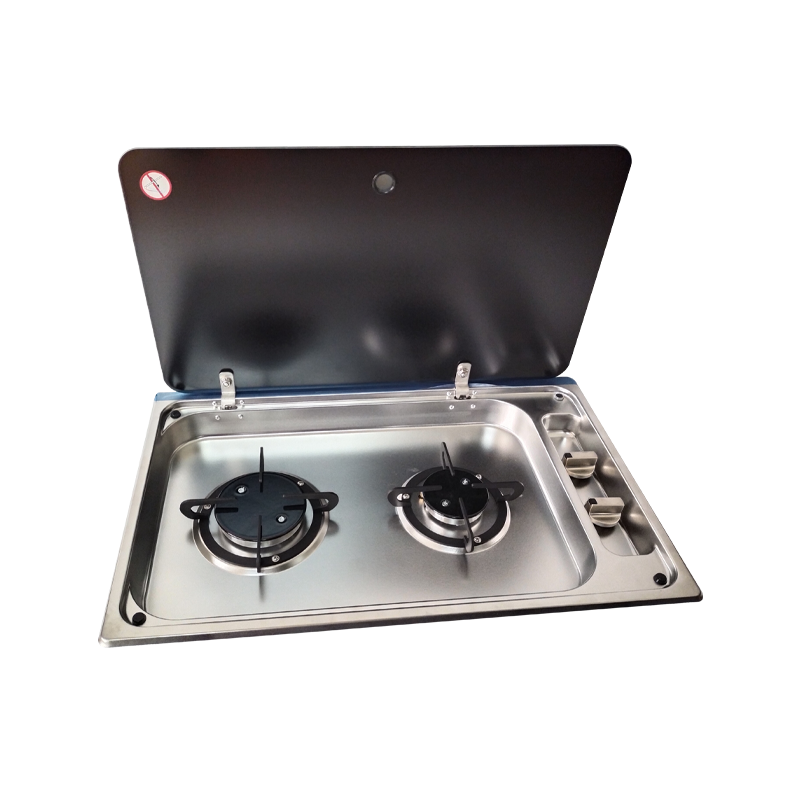
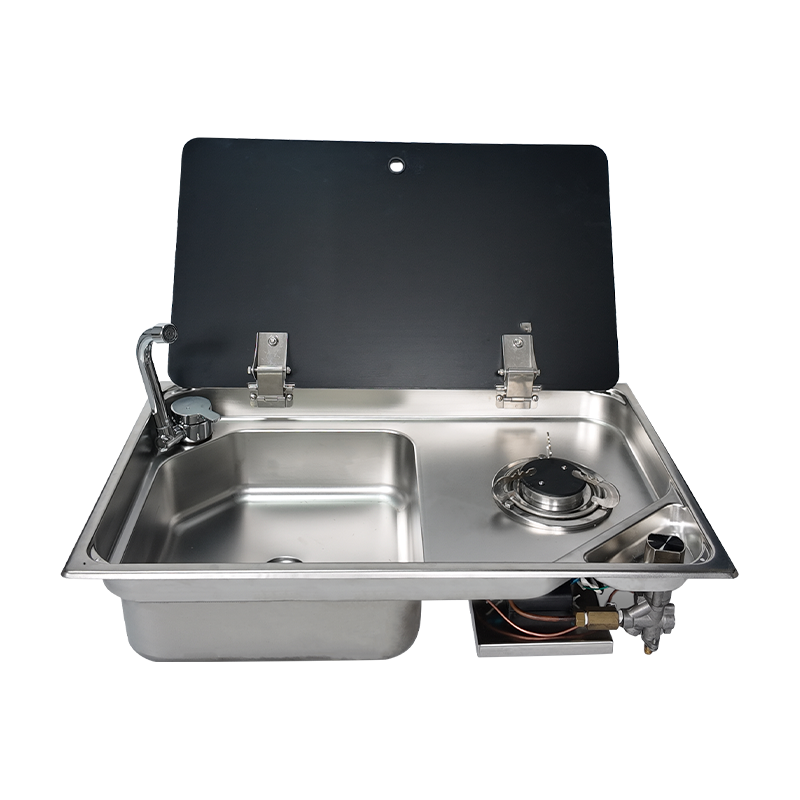
Where the lid shares a frame with a cooking appliance, the material choice widens. A two burner gas stove with a safety glass lid combines the hob and bowl in one pressed and welded assembly, which simplifies the cutout but makes the heat rating and the gas connection the critical checks.
 Stainless Steel Two Burner Gas Stove with Safety Glass LidA compact two-burner stainless gas stove with tempered safety glass lid, measuring 550 x 350 x 110 mm for RV and mobile kitchen use.View Product →
Water Supply, Drain and Lid Clearance
Lid clearance and plumbing compete for the same 150 mm behind the bowl. A folding lid that stands upright needs the tap spout to sit forward of the hinge line, otherwise the two meet halfway through the fold. Underneath, the trap depth sets how far the bowl can sit from the cabinet back, and the drain outlet position decides whether the waste pipe runs behind or beside the unit.
It helps to understand how water reaches the bowl in a camper kitchen before fixing the sink position, because pump pressure, accumulator placement and the fresh water tank height all influence how the tap behaves. A low mounted tap on a shallow bowl will splash more, and a splash that lands on the hinge of a glass lid is a splash that finds its way under the frame.
A Practical Checklist Before Approving a Drawing
- Confirm the closed height of the lid above the worktop, including the frame and any handle.
- Confirm the open position: fold flat, stand upright, or lift off, and the clearance each one needs.
- State the cutout dimensions with a tolerance and the corner radius.
- Name the stainless grade, the bowl thickness and the finish on both bowl and lid frame.
- Decide between gas struts and friction hinges, and note the expected service life.
- Check tap position against the hinge line and the tap height against the lid arc.
- Verify trap depth and drain outlet direction against the cabinet layout.
- Agree edge treatment, deburring and packaging, since a lid that shifts in transit arrives scratched.
Custom Sink Programs and What to Send
For volume orders, the sensible route is a manufacturer working from drawings or samples rather than a catalogue. Ningbo Dasheng Metal Products runs in house tooling design and production, holds ISO9001:2015 certification, and works from 4T to 1000T mechanical presses with hydraulic presses up to 1000T. Its deep drawing capability reaches 450 mm in depth and 1000 mm in diameter, with stamping up to 1300 mm by 1000 mm and material thickness to 20 mm, across a plant of roughly 10,000 square metres and annual capacity near five million pieces.
Send the bowl drawing, the lid geometry, the material grade, the surface finish, the hinge specification and the packing requirement. Photographs of a sample sink help more than a paragraph of description, especially for rim shape and hinge mounting. Buyers who want to compare bowl sizes and lid styles before committing to a tool can review the full RV sink range as a starting reference.
A lid is a small component with a long list of dependencies: hinge clearance, tap position, cutout tolerance, stainless grade and the depth of the trap below. Settle those five points before the worktop is cut and the rest of the installation follows quietly. Settle them afterwards and every one of them becomes a modification.
related products
Send An Inquiry
Don't hesitate to contact when you need us!
Whether you want to become our partner or need our professional guidance or support in product selections and problem solutions, our experts are always ready to help within 12 hours globally
contact Us
Phone: +86 18157484296
FAX: +86 574-86150176
E-mail: [email protected]
Address: Unit 2, Building 19, Zhichuangzhizao Park, Chengdong Industrial Zone, Xiangshan, Ningbo,315705, Zhejiang, China
Product Category
Mobile