中文简体
 Español
Home / Resources / Industry News / stainless steel camper sink: Applications, Selection Criteria, and Practical Guidance
Industry News
Nov 05,2026
stainless steel camper sink: Applications, Selection Criteria, and Practical Guidance
Content
- 1 Why 304 Stainless Steel Is the Default Choice for Camper Sinks
- 2 Wall Thickness, Weight and Where the Cost Actually Sits
- 3 Cutouts, Rim Overhang and Fit Tolerances
- 4 Sink Formats for Camper, Motorhome and Boat Kitchens
- 5 What Deep Drawing Contributes to a Sink That Lasts
- 6 Drainage, Water Supply and the Callbacks They Cause
- 7 A Sourcing Checklist for Camper Sink Buyers
A camper galley compresses a full kitchen into about a metre of counter, and the sink sits at the centre of that compromise. It holds several litres of water while the vehicle is moving, it carries the weight of a filled pot, it gets splashed with acidic food residue and scrubbed with abrasive pads, and in coastal use it meets salt air on both sides of the bowl. Replacing a cracked acrylic basin is one of the most common interior upgrades owners make, and most of them end up asking for stainless steel.
The short version: specify 304 stainless steel, 0.8 mm to 1.0 mm sheet thickness, a bowl drawn in one piece with no welded seam at the bottom radius, a cutout tolerance no looser than plus or minus 1 mm, and a drain outlet positioned to clear the drawer stack or water heater below. Grade and forming method decide whether the sink survives a decade of vibration. Lid style, rim width and polish level are cosmetic decisions that come later.
Why 304 Stainless Steel Is the Default Choice for Camper Sinks
Type 304, often written 18/8, carries roughly 18 percent chromium and 8 percent nickel. Chromium builds the passive oxide film that stops rust, and nickel keeps that film stable while the steel is being stretched. A sink bowl is stretched hardest at the bottom radius, so nickel content is not a marketing detail. It is what keeps the drawn corner from becoming the first place to pit.
Cheaper imports often substitute type 201, which swaps most of the nickel for manganese. It presses well enough and looks identical after polishing, but in a damp camper stored through winter, or on a vehicle that sees coastal roads, the reduced nickel and chromium balance shows up as tea staining and then as pitting. Ferritic grades such as 430 are magnetic, form poorly at tight radii and belong on decorative trim, not on a bowl that holds water.
| Grade | Nickel content | Corrosion resistance | Behaviour in deep drawing | Sensible use |
|---|---|---|---|---|
| 304 | 8 to 10.5 percent | Good in fresh water, food acids and moderate salt | Stable, low risk of strain cracking | Standard choice for camper, caravan and boat sinks |
| 201 | 3.5 to 5.5 percent | Fair, pitting risk in chlorides | Work hardens quickly, needs higher press tonnage | Low cost inland use with short service life expectations |
| 316 | 10 to 14 percent plus molybdenum | Best of the group under salt exposure | Similar to 304, higher material cost | Coastal and marine galleys |
| 430 | None, ferritic structure | Limited, stains in damp storage | Poor at deep radii, cracking risk | Trim rings and decorative parts only |
For most camper and motorhome kitchens, 304 is the balance point between corrosion life and cost. Reserve 316 for boats and for vehicles that spend the season beside salt water.
Wall Thickness, Weight and Where the Cost Actually Sits
Thickness is the second decision and the one most easily fudged in quotations. Many caravan sinks are drawn from 0.8 mm sheet, which is adequate for a hand basin that sees light use. Heavier galley bowls, particularly combinations that carry a gas hob on the same pressing, usually move to 1.0 mm or 1.2 mm for stiffness at the rim.
The weight penalty is real but modest. A rectangular bowl of about 400 by 350 mm drawn from 0.8 mm sheet lands near 1.3 to 1.5 kg. The same bowl in 1.2 mm lands around 2.0 to 2.2 kg, which matters in a van conversion where every kilogram is counted, but usually matters less than the flex that a thin rim develops once a full pot is set on it.
- Rim flatness: a rim that is not flat will not seal against the gasket, and the leak appears only after the counter is installed.
- Oil canning: thin bottoms drum in and out under a running tap and eventually crack at the drain boss.
- Sound deadening: an applied pad or a sprayed coating reduces the drumming noise that owners notice immediately in a quiet campsite.
Cutouts, Rim Overhang and Fit Tolerances
Most camper sink callbacks are not corrosion failures, they are fit failures. The counter cutout is usually specified at plus or minus 1 mm, and the rim overhang beyond the cutout should stay between 15 mm and 25 mm so the sink clamps evenly without crushing the counter core. Corner radii below 10 mm concentrate stress in both the sink and the laminate.
Two dimensions deserve a check before tooling is cut. The first is bowl depth against the drawer or appliance below, since a 160 mm bowl will not clear a 130 mm drawer box. The second is lid clearance, because a glass lid that folds back needs open space above the counter and a hinge that does not foul the tap when the lid is raised. Tap hole diameter is commonly 35 mm, but confirm the fitting rather than assuming it.
Sink Formats for Camper, Motorhome and Boat Kitchens
Four formats cover almost every conversion, and each solves a different space problem rather than a different cleaning problem.
| Format | Typical outer size | Typical bowl depth | Best fit |
|---|---|---|---|
| Round hand basin | 300 to 360 mm diameter | 110 to 150 mm | Wet bath, wash area, compact van |
| Rectangular single bowl | 380 x 340 to 420 x 360 mm | 130 to 160 mm | Galley with drawers underneath |
| Single bowl with glass lid | 400 x 350 to 450 x 380 mm | 130 to 160 mm | Galley that needs the lid as extra work surface |
| Cooker and sink combination | 500 to 700 mm wide | 120 to 150 mm | Tight layouts where hob and bowl share one pressing |
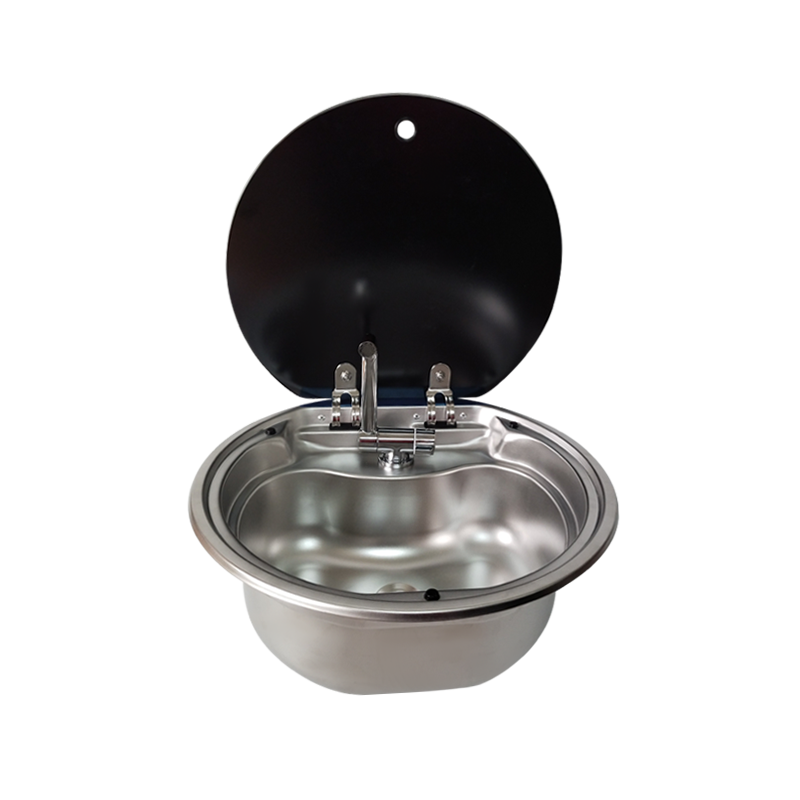
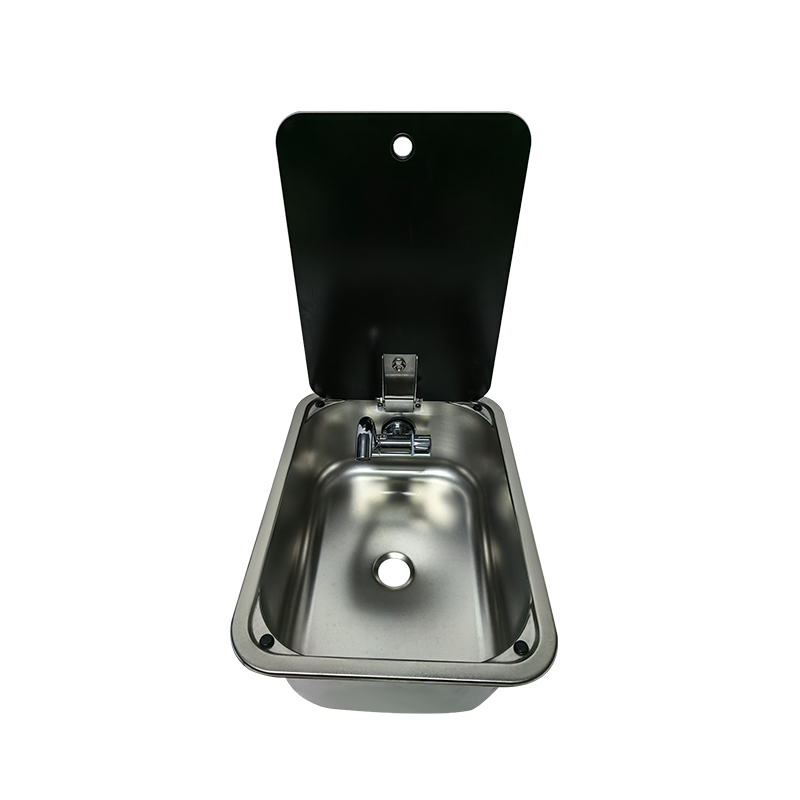
The round basin is the simplest to tool and the easiest to fit into a corner, which is why it appears so often in wash areas rather than in cooking zones. A polished 304 basin of this type also works on boats, where the same corrosion argument applies with more salt in the air.
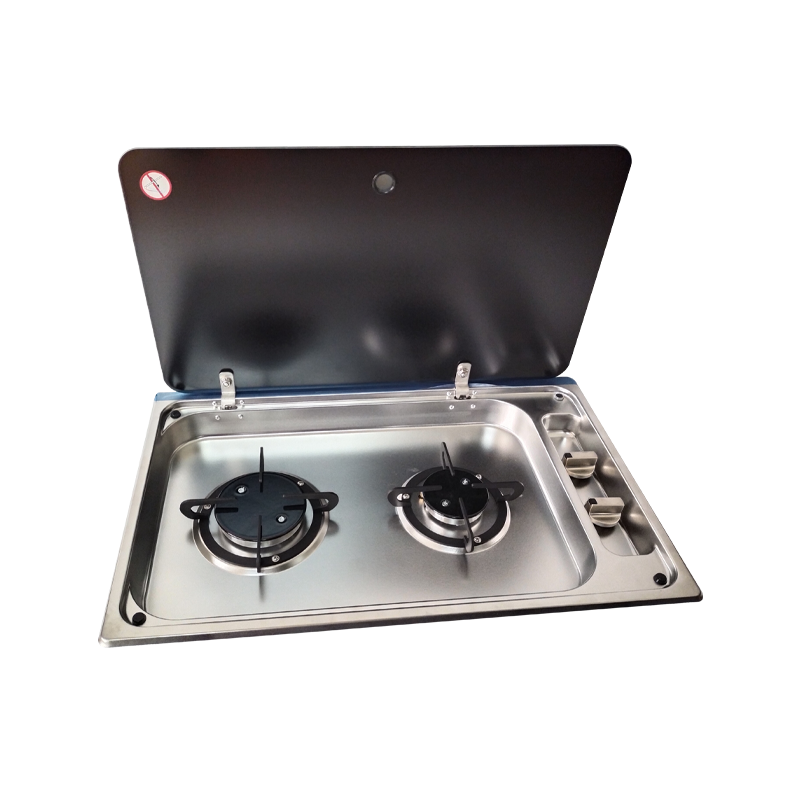 Hob Sink Combo Range for RV and Campervan KitchensExplore stainless steel sink and cooking units with glass lids for RV, campervan, caravan and motorhome kitchens, including round basins and integrated combi formats.View Product →
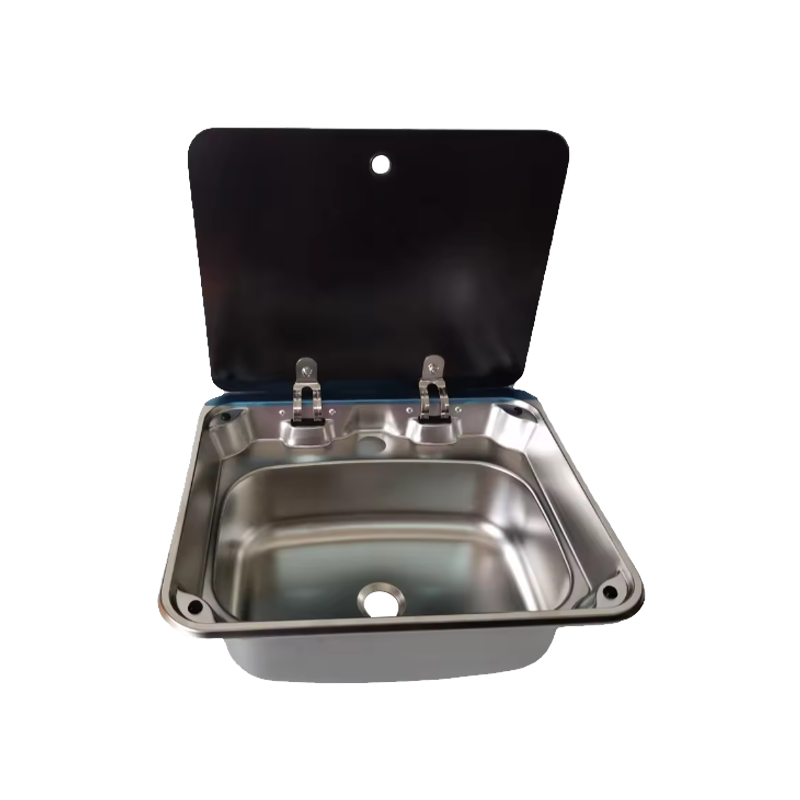
The single rectangular bowl with a folding glass lid is the format most owners specify when they cook inside. The lid closes the bowl while travelling, stops splashing on a rough road, and adds roughly a third of a square metre of usable bench when it is down.
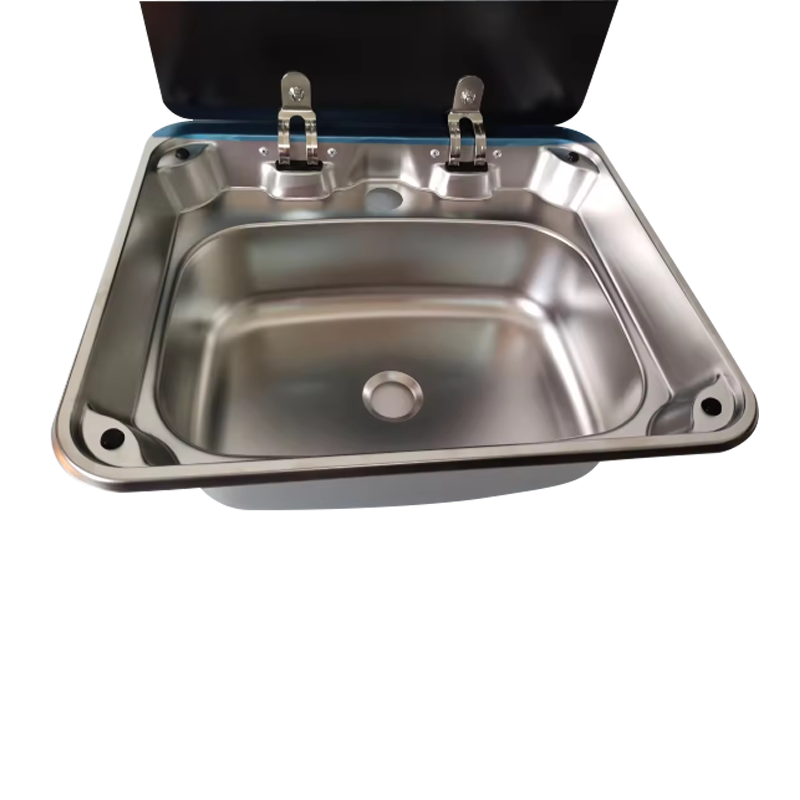 304 Stainless Steel Rectangular RV Sink with Glass LidSingle-bowl 304 stainless steel sink with tempered glass lid and polished finish, a rectangular format suited to RV, caravan, motorhome and boat kitchens.View Product →
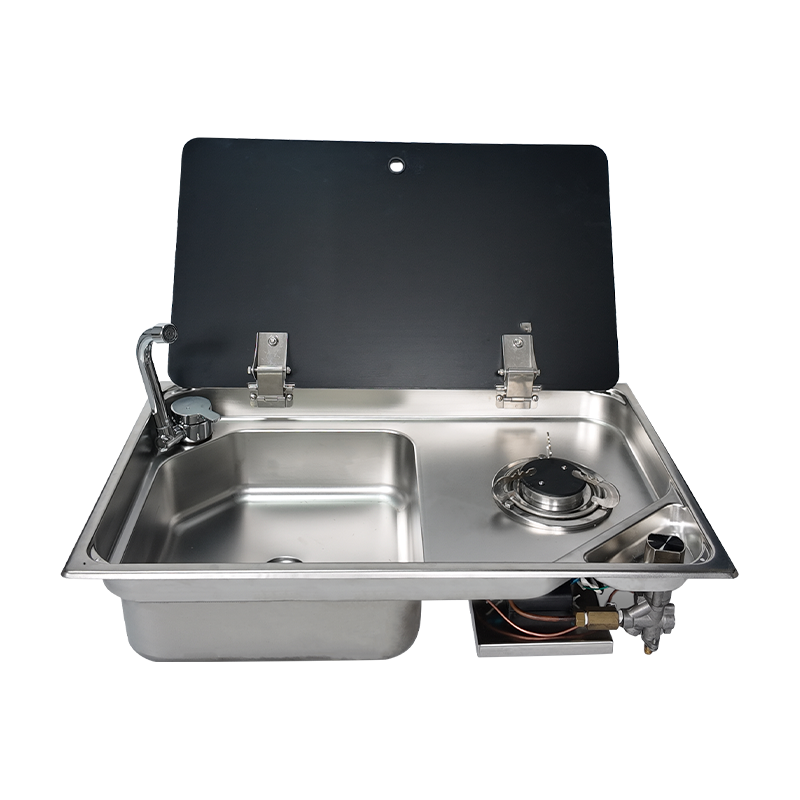
Where space is genuinely tight, a combined cooker and sink unit removes a cutout and a seam from the counter. The trade off is that the whole unit must be replaced if either half fails, so the grade and the weld quality matter more than they do on a stand alone bowl.
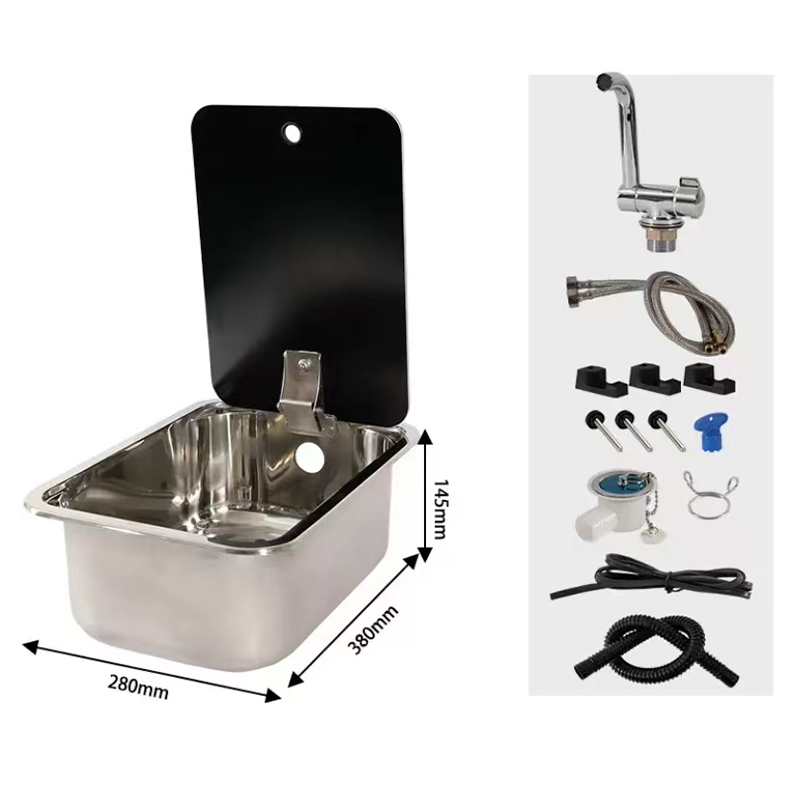 304 Stainless Steel RV Cooker Sink with Tempered Glass CoverCompact 304 stainless steel cooker sink with tempered glass cover and passivated polished finish, sized for RV, caravan, motorhome, boat and yacht kitchens.View Product →
You can compare these formats side by side in the RV and camper sink range before requesting samples.
What Deep Drawing Contributes to a Sink That Lasts
A sink bowl is a deep drawn part, not a folded box. Drawing the bowl and rim from a single blank removes the four corner welds that would otherwise sit exactly where water and cleaning chemicals collect. Welded corners can be dressed and passivated to look correct on the bench, but the heat affected zone remains the weakest point after two or three seasons of vibration.
Draw depth drives the tooling. A bowl of 150 mm to 200 mm depth with a generous bottom radius is routine on hydraulic presses in the 315 t to 630 t range, while deeper or narrower geometries need more stages, more annealing control and better lubrication to avoid tearing at the punch radius. Suppliers with press capacity from small mechanical units up to 1000 t, blank sizes around 1300 by 1000 mm and draw depth capability of roughly 450 mm can usually hold a camper sink in two or three operations.
Finishing decides how the part feels in the hand. A vibratory deburr followed by polishing and a passivation rinse removes free iron from the surface, which is the usual cause of rust spots that appear on a brand new sink after the first wash. Manufacturers working to ISO 9001:2015 typically document the passivation step and the incoming mill certificates, and that paperwork is what an OEM buyer should ask for rather than a sample photograph.
Drainage, Water Supply and the Callbacks They Cause
The drain boss is a small feature that generates a disproportionate number of complaints. Outlets of 1 3/4 inch and 2 inch are both common in leisure vehicles, and the choice is usually dictated by the trap and waste pipe already in the conversion rather than by the sink. Check the boss height under the bowl, because a deep boss can foul a shallow trap or a heater duct that the drawing did not show.
Water supply deserves the same attention. A camper sink is normally fed from an onboard tank through a pressure or diaphragm pump, with a separate cold feed and, on larger vehicles, a small hot water cylinder. Low flow at the tap is more often an undersized feed line or a blocked aerator than a sink defect, and it is worth reading how the feed and drain route together in what supplies water to the RV sink before signing off a layout.
A Sourcing Checklist for Camper Sink Buyers
- Confirm the grade in writing as 304, with the mill certificate attached to the first article inspection report.
- State sheet thickness explicitly, and state where it is measured, since rim and bowl are often different.
- Give the cutout drawing with corner radii, rim overhang and a tolerance of plus or minus 1 mm.
- Specify drain outlet size, boss height and the distance from the bowl centre to the rear edge.
- Define the surface finish in measurable terms, such as polished, satin or vibration finished, and say which faces are visible.
- Ask for the drawing of the glass lid hinge and its open position clearance, not just the sink outline.
- Agree on packing that survives pallet stacking, because a dented rim in transit fails the same inspection as a bad draw.
A camper sink looks like a simple pressed bowl, and that is exactly why it is so often under specified. The parts that fail are predictable: a 201 grade bowl in a coastal vehicle, a welded corner that was never passivated, a rim that will not sit flat on a laminate top, or a drain boss that collides with a drawer. None of these are difficult to prevent at the drawing stage.
Get the grade, the draw method and the cutout tolerance right, and the sink becomes one of the few items in a conversion that never comes back for a second look.
related products
Send An Inquiry
Don't hesitate to contact when you need us!
Whether you want to become our partner or need our professional guidance or support in product selections and problem solutions, our experts are always ready to help within 12 hours globally
contact Us
Phone: +86 18157484296
FAX: +86 574-86150176
E-mail: [email protected]
Address: Unit 2, Building 19, Zhichuangzhizao Park, Chengdong Industrial Zone, Xiangshan, Ningbo,315705, Zhejiang, China
Product Category
Mobile